
THE CARMARTHENSHIRE MOTH GROUP WOULD LIKE YOUR HELP.
They are looking for records for the day-flying Scarlet Tiger moth (Callimorpha dominula). This distinctive, very colourful moth likes damp grassland, coastal habitats and, occasionally, gardens. It was once quite common in Carmarthenshire, but there have been few records of sightings since 2000. 
Scarlet Tiger moths (wing span 45–55 mm) fly in sunshine in June and July, particularly during late afternoon. The young caterpillars feed on species such as comfrey and hemp agrimony. When larger the caterpillars are often found feeding on nettles, brambles, willows, honeysuckle and meadowsweet.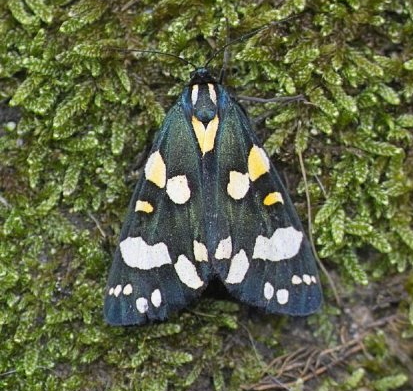
If you do see this moth then please get in touch through the contact below. If possible take a photo and give the name of the site where you saw it and the date. Also, do record the grid reference if you can (See UK Grid Reference Finder to help you do this http://gridreferencefinder.com ).
There are other tiger moths for which the moth group would like records – so keep your eyes peeled…
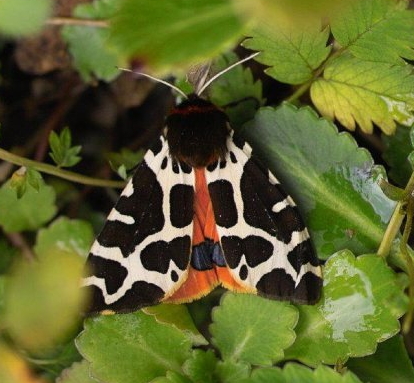
The Garden Tiger, Arctia caja, (pictures above), (50–78 mm) – flies in July and August . It’s still regularly recorded but is declining in numbers.
The Cream-spot Tiger, Arctia villica britannica, (45–60 mm) – flies in May-June. There is one old record from Kidwelly, but does it still occur in the county?
The Jersey Tiger, Euplagia quadripunctaria, (52–65 mm) – flies from mid-July-September. No records in the county as yet, but this very rare moth has now been recorded in south Wales. Look on buddleia and thistles, along the coast.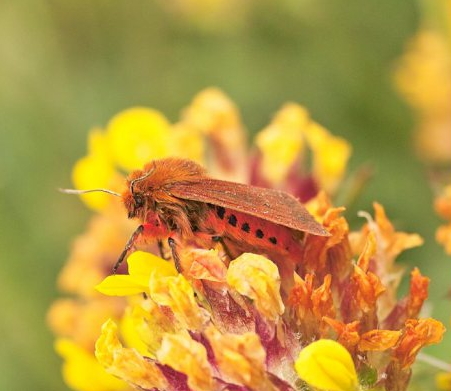
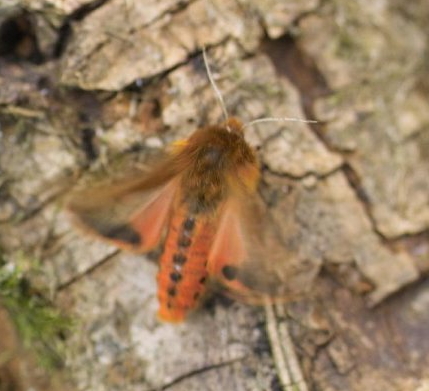
There is also a less rare Ruby Tiger, Phragmatobia fulginosa, (28-38mm) – which can have 2 generations per year, so flies in April to June, and again in July to September. (pictures above).
So why not join the ‘tiger hunt’!
With thanks to I.Morgan, for much of the text.
Please contact: Biodiversity Officer, 01558 825390, Biodiversity@carmarthenshire.gov.uk
Find out more: http://www.carmarthenshiremoths.co.uk
______________
HOFFAI GRŴP GWYFYNOD SIR GAERFYRDDIN GAEL CYMORTH GENNYCH!
Rydym yn awyddus i gael cofnodion o’r teigr ôl-adain goch Callimorpha dominula, sef math o wyfyn sy’n hedfan yn ystod y dydd. Glaswelltiroedd llaith, cynefinoedd arfordirol ac, yn achlysurol, gerddi yw cynefinoedd y rhywogaeth drawiadol hon. Arferai fod yn eithaf cyffredin yn Sir Gaerfyrddin ond prin yw’r cofnodion sydd wedi dod i law ers 2000.
Mae teigrod ôl-adain coch (y mae lled eu hadenydd yn 45–55mm) yn hedfan yn yr heulwen yn ystod misoedd Mehefin a Gorffennaf, ac yn enwedig yn hwyr yn y prynhawn. Bwyd y lindys yw planhigion megis llysiau’r cwlwm a byddon chwerw. Ar ôl tyfu rhywfaint, yn fynych gwelir y lindys ar ddynent, mieri, helyg, gwyddfid ac erwain. Cofiwch gysylltu â ni os gwelwch chi’r gwyfyn hwn. Os oes modd tynnwch lun a rhoddwch enw’r safle a’r dyddiad. Os oes modd rhoddwch y cyfeirnod grid (Gall yr UK Grid Reference Finder – http://gridreferencefinder.com eich helpu i wneud hynny). Yn ogystal rydym yn awyddus i gael cofnodion o deigrod eraill – felly cadwch eich llygaid ar agor. 
Teigr yr ardd (50–78mm) – mae’r rhywogaeth hon yn hedfan yn ystod misoedd Gorffennaf ac Awst – cofnodir y gwyfynod hyn yn rheolaidd o hyd ond mae’r niferoedd yn lleihau.
Teigr ôl-adain felen (45–60mm) – mae’r rhywogaeth hon yn hedfan yn ystod misoedd Mai a Mehefin. Mae gennym un hen gofnod o Gydweli – a yw’r rhywogaeth hon yn dal i fod yn y sir?
Teigr Dyfnaint (52–65mm) – mae’r rhywogaeth hon yn hedfan o ganol mis Gorffennaf tan fis Medi. Nid oes dim cofnodion yn y sir hyd yn hyn, ond mae’r gwyfyn prin hwn wedi ei gofnodi bellach yn Ne Cymru.
Edrychwch ar lwyni cynffon las ac ar ysgall ar hyd yr arfordir!
Felly beth am gymryd rhan yn ein ‘helfa teigrod’!
Manylion cyswllt: Swyddog Bioamrywiaeth, 01558 825390, bioamrywiaeth@sirgar.gov.uk
I gael rhagor o wybodaeth gweler:
http://www.carmarthenshiremoths.co.uk
 Carmarthenshire Meadows Group - Grŵp Dolydd Sir Gaerfyrddin