
Very many thanks to Andrew and Helen Martin for this great insight into how they’re tackling the important issue of small scale hay making on their small holding near Dryslwyn : 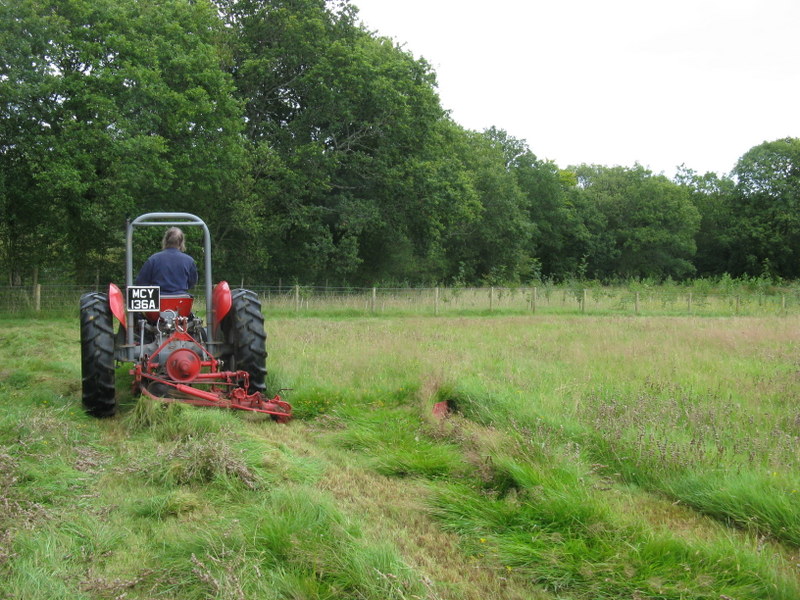
Our small (c. 1 acre) meadow is only in its second year of restoration. Last summer we got our farmer neighbour to cut and bale the field for us, and he kept the haylage. It probably took him about 15 minutes to mow the field with his large disc mower, and about 20 minutes to bale it a couple of days later, and I think he got 5 or 6 big round bales from it. But this summer we did it ourselves. It was always our intention to gradually acquire the kit (second hand if possible) to maintain the meadow, and this year was the first time we’ve done it. In 2016 the field next to it will become a hay meadow as well, so we’ll be doing both. Soon after moving to our smallholding we bought (via e-bay) an old tractor, a 1963 Massey Ferguson 35. I was fairly used to working on old cars, so it wasn’t daunting to check it over before buying it. It was money very well spent, and has been used several times a week ever since, for various duties but most often with a topper for cutting ours, and our neighbours, pasture fields.
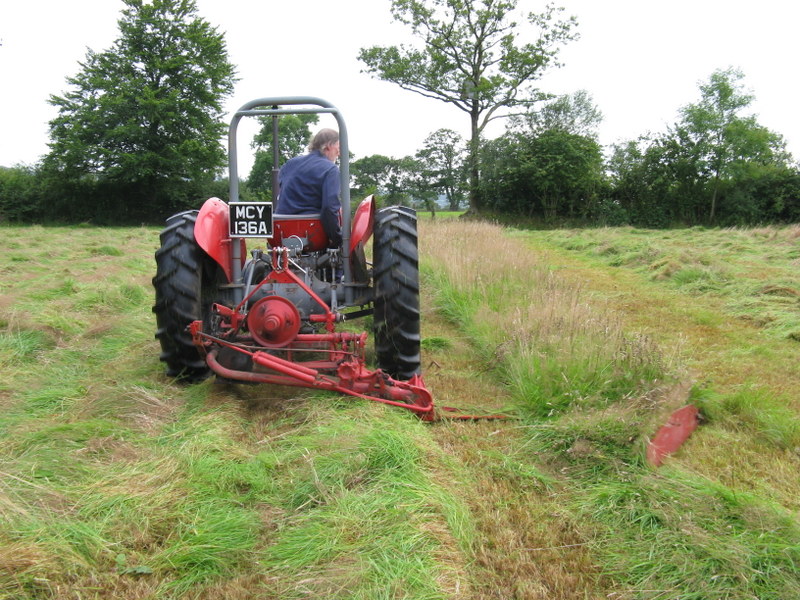 However, the mower we used for cutting our meadow was an International Harvester B23 finger bar mower, also found on e-bay. This is probably about the same age as the tractor, and was state of the art hay cutting equipment at the time.
 Farmers today would not consider using such a mower, as compared to modern drum or disc mowers it is small, slow, complicated to set up (we found a user manual of ebay which was very useful) and in a lush crop of silage it would keep clogging up and need unblocking every 20 feet or so. But on a small meadow with suitably impoverished soil it works well. It probably took about 90 minutes to do the field.
 To turn the hay for drying, we originally intended to look for a Vicon Acrobat, the implement with 3 large multi-tined wheels which can be set to either turn the hay or put it into windrows ready for baling. However we decided against it, as it needs to work in straight lines, and in our small fields there is a lot of edge for the amount of middle. We therefore looked for 1970’s technology rather than that of the ’50s and ’60s and found a second hand Haybob. This (e-bay again) works extremely well either for fluffing up the hay to aid drying or, after resetting its tines to the raking/rowing position, it does an excellent job of making windrows ready for baling.
 Unlike the Acrobat, it will work on the turn which is very useful in small fields. The width of the rows is determined by how you set the gates at the back.
 For baling, we originally bought (yet again from ebay) a New Holland Hayliner 68 small square baler, from another smallholder in a nearby village who was selling up to move to California. It arrived too late for last year’s cut, and so we got our neighbour to do it. But during the succeeding months I decided it was not ideal for our purposes. Firstly, it weighed more than the tractor which is a bit worrying on a downhill slope when approaching the fence, and it can’t make sharp turns which is a problem in small fields. Secondly, the 35 only has just enough power to operate it, which is worrying on an uphill slope. And thirdly, given the late cut our meadow needs to allow the annuals (especially the yellow rattle) to drop its seeds, we would find it very difficult to find enough consecutive dry days to dry the crop sufficiently to bale hay that would not go mouldy.
 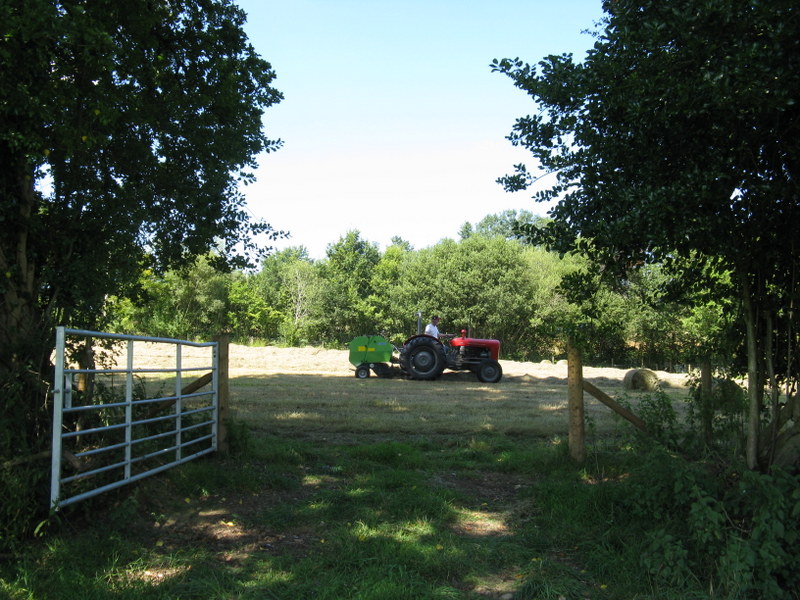 We therefore sold the old baler, and spent rather more money on a new mini baler and wrapper. These are made primarily for small farms in developing countries, and are designed for small (or modern compact) tractors. It produces round bales, but they are only a couple of feet in diameter and just over that in length.
 They weigh about the same as a conventional square small bale. The machine runs on its own wheels when working, but is small enough for the tractor to be able to pick it up at the end of a row and turn sharply to start the next one. Best of all, the wrapper that goes with it allows us to wrap the bales so we can produce haylage instead of hay bales, so we do not need at least five days of dry weather.
  In fact we did it in four, cutting on afternoon of Saturday 15th August, fluffing up late Sunday morning and again late afternoon, again late Monday morning then rowing up Monday late afternoon, then baling and wrapping Tuesday, ready for the resumption of heavy rain Wednesday onwards.
 Another benefit of the wrapped bales is that they don’t have to be stored under cover.
  We have already sold them to a friend who has a lot of sheep, some of whom are going to be doing our aftermath grazing.
  So although it is in no way cost effective, harvesting our own field was fun, and very satisfying. It all went without a hitch, nothing broke down. It is probably beginners’ luck and will never go so smoothly again, but at least we know it can be done!
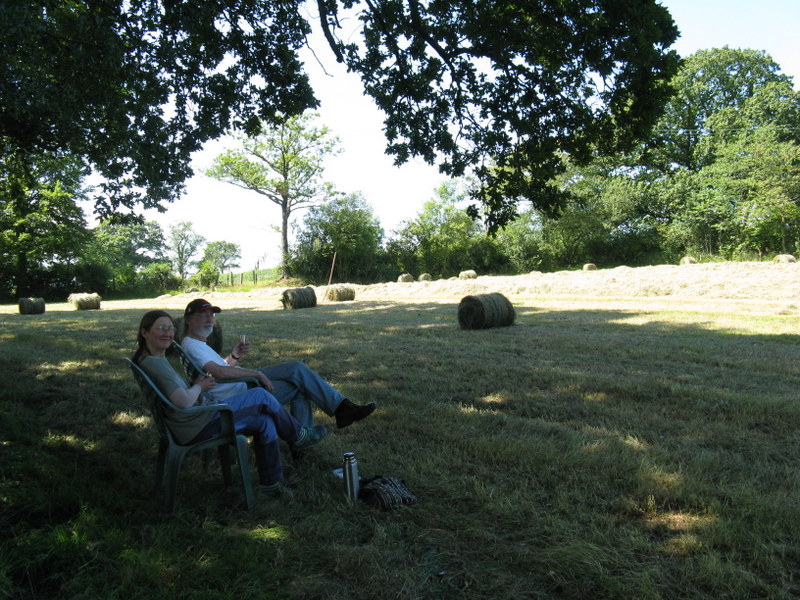 I’m sure Andrew and Helen would be happy to answer any questions or comments about their experiences which you can post below.
 Carmarthenshire Meadows Group - Grŵp Dolydd Sir Gaerfyrddin