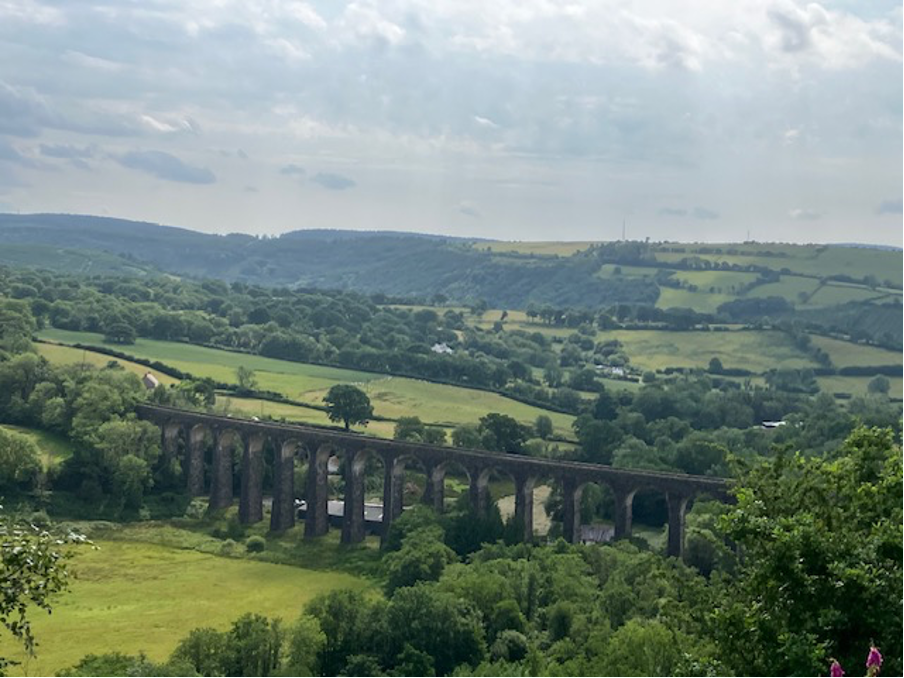
This is a brief article about the visit by CMG members made to the Carbon Community. If you’re not aware of what the Carbon Community (CC) does, this isn’t really the place to go into it in great depth, you can read about it here: https://www.carboncommunity.org/?gclid=EAIaIQobChMIqLX_1Ozq_wIV0OPtCh1E-gzaEAAYAiAAEgLllvD_BwE , but very briefly, it’s a charity that bought a 70 hectare area of farmland N of Llandovery.
The Carbon Community conducts scientific research into the best ways of using tree planting to achieve maximum carbon sequestration in trees and soil. The research projects running at present are described on the website, and include detailed soil measurements of carbon content and other parameters, comparisons of growth rates of various tree species in different conditions, soil fungi and their associations with tree roots, and a survey of invertebrates. They are mostly concerned with the tree planted areas, but the grasslands are used as controls for comparison with the tree planted sites. Heather, Charles, and Sonia of CC led the tour of the site’s impressive hay meadows, grasslands and wetter Molinia and peat areas.

Ivy Denham (of Conservation and Trees), who is one of the members of the CMG steering group, surveyed the site a couple of years back when CC bought it, and identified several areas of conservation importance including areas of peat (an extremely important carbon store), some wet grassland which has potential as a habitat for Marsh Fritillary Butterflies (there is Devil’s-bit Scabious there), and large areas of species rich drier grassland in the form of hay meadows. Ivy advised CC on how best to manage these areas for the future, and as our hosts agreed, they are areas that should not be planted with trees. Ivy led a tour of the grasslands on the previous day, not for us in CMG but for the volunteers at the carbon community and unfortunately, she wasn’t able to come on the Sunday. But those of us who were there had useful discussions with our hosts about the role that grasslands (and especially peatlands) can themselves play as sites for carbon sequestration. The peat areas especially sequester large amounts of carbon, so need to be managed in such a way that they won’t dry out and release lots of CO2.
The research projects currently running are not conducted by CC themselves, but by various university projects. Heather, Charles, Sonia, and the CC volunteers give of their time freely, but funding and volunteer time are both limited, so the priority must be the tree planting research which is what CC was set up to do. We hope that in the future, more resources may become available to manage the wetter grasslands and the peat areas in the optimum way, and maybe to expand the research and soil carbon measurements in detail into all the grassland areas. Ivy is working with CC to investigate using cattle to graze some areas rather than the sheep that are there currently, using fenceless grazing collars, water bowsers and so on. There is a lot of expertise at the NBGW on using green hay to increase species richness in less complex areas, and the orchid fields at CC are certainly ideal green hay donors, so we are hoping to cooperate with CC and combine their own expertise with that of the grassland/peatland specialists associated with CMG.

It is true that CC are currently focusing solely on tree planting as a carbon capture method. However, that is what the charity was set up to do, and given the very large grants currently available to landowners to plant trees for carbon capture it is a very good thing that CC are making such a valuable contribution, by enabling detailed research into how to do it most effectively. But the emphasis may change somewhat in the not-too-distant future; as knowledge of soil carbon in habitats other than woodland increases. For example, Plantlife are formulating a proposal to be delivered to the UK government and each of the UK national governments, to develop policies encouraging the conservation of various categories of grassland, not only for their biodiversity (in the face of the nature crisis) but also for their carbon storage potential. CMG and the Big Meadow Search project will both be signatories to the document to be sent to the Welsh Government.
Overall, it was a very interesting visit to a unique site. CC are limited by volunteer time and funding in what they can quickly achieve to optimally manage and to conserve the non-tree planting areas, but the site contains some valuable habitats, with great conservation potential as well as very valuable research into the best way to use trees for carbon capture. Charles, Heather, and Sonia were welcoming hosts, and we had interesting conversations and discussions with them about the possibilities for carbon capture by land under different types of management in addition to tree planting. We thank them very much for their hospitality and a very interesting visit, and I thank Laura Moss for the use of some of her photos.
If you would like to add your own comments, please use the “Leave a reply” facility below.
Andrew Martin
 Carmarthenshire Meadows Group - Grŵp Dolydd Sir Gaerfyrddin