One of the aims of Carmarthenshire Meadows Group (and all Meadows Groups) is to increase the area occupied by species-rich grassland in our county. We hope to encourage landowners to manage their grassland, whether it’s on a garden scale or a field scale, in a way that encourages a wide range of grassland plants to establish. One way of doing this is by using “green hay”- and you can read about how successful this has been at the National Botanic Garden of Wales (NBGW) here: https://carmarthenshiremeadows.com/2021/07/05/further-green-hay-experiments-at-nbgw/
Another method is to use seed harvested from a species-rich donor site to sow on a less species-rich receptor site. This has advantages over the use of green hay in that seeds can be collected on more than one occasion from a donor field when different species are seeding, and there is not the limitation that the green hay has to be transported and spread quickly before it heats up and kills any seeds it contains. They are doing seed collection at NBGW as well, using a brush harvester to collect seed from the Waun Las meadows. Their brush harvester is a self-powered machine towed by a quad bike, and there is a talk on our YouTube channel by Dr Kevin McGinn on the NBGW Seed bank and how they are using their brush harvester here: https://www.youtube.com/watch?v=a4NvI7OLyME&t=20s
The committee that runs CMG had discussions about whether it would be a useful thing for our group to acquire, as some of our members’ sites would certainly make suitable donors, and other members not so far along the species-rich road would certainly like to try sowing seeds from the donor sites – you might have taken part in a survey we did to gauge the membership’s views on this a year or so back.
One of the drawbacks of the quad bike style brush harvester is that it does leave quite a trail of flattened meadow in its wake. Another is that you need to have a quad bike to tow it, and transporting both of them is not easy.
But there are alternatives – the Marches Meadow Group (based both sides of the border in Shropshire and Powys) bought a walk-behind seed harvester – the Grass Grabber. The photo below shows their seed harvester in action – photo published with permission of and credit to © Sarah Jameson

The Grass Grabber is a machine with bicycle type wheels made in Australia, and it’s actually intended to collect grass seeds. Below are some photographs which show the wheels etc more clearly and kindly provided by the manufacturer:


The Marches Meadows Group had grant funding to help pay for the machine, which (after import tax, and the cost of transporting it across the world) is about as expensive as a quad bike towed brush harvester. As an unincorporated organisation, CMG is not eligible for many of the grants that charities can apply for. There are also a lot of problems associated with group ownership of machinery – who looks after it, who pays for servicing and repair, if anyone can use it will it get damaged, etc.
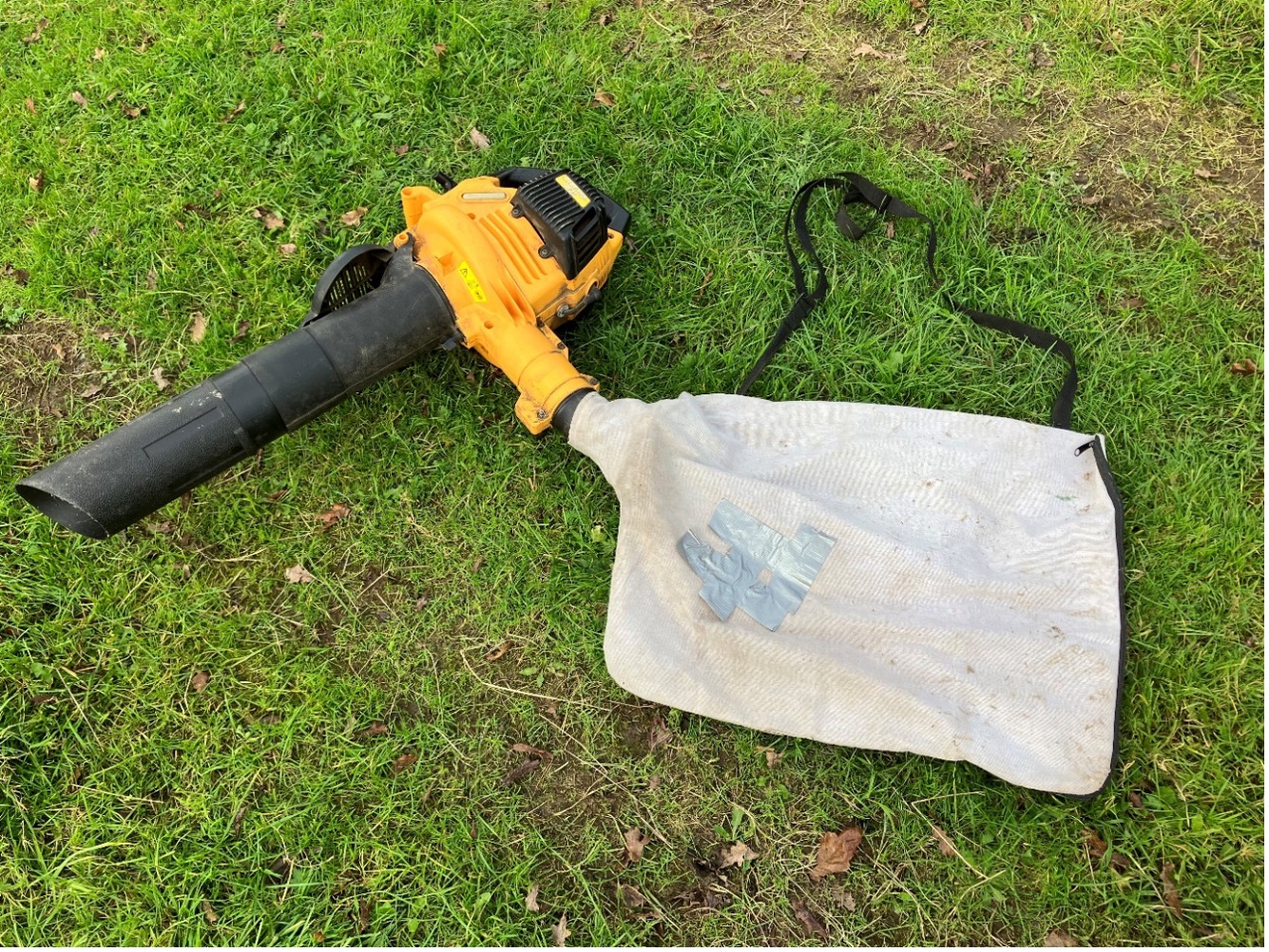
We decided to look into a much less costly option – a leaf vacuum. Many models of leaf blower are available, and some have a facility for a cloth bag to be attached where the air is blown out, and a pipe attached to the air intake. I already had an elderly example of such a device which I’ve used for collecting sawdust and shavings after cutting up firewood.
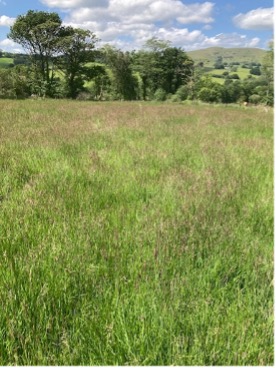
So, we decided to try it out as a method of collecting seeds from a meadow. We chose the donor site – an area of about 25m2 in a field on APM’s smallholding in Cwrt Henri – where there were a good range of species including Whorled Caraway, Yellow Rattle, Eyebright, Self-heal, Greater Bird’s-foot Trefoil, Lesser Trefoil, Cat’s Ear, Common Knapweed, and Red Clover.


The leaf vacuum was used to hoover up seeds from the area chosen, which took about 10 minutes. There were seeds, and quite a lot of chaff – non-seed plant material – in the bag. It was emptied, and the contents weighed – there were 186g of material. It seemed dry, so we decided it wasn’t necessary to dry it any further, nor did we sieve it or sort it in any way, and we took it to LJM’s smallholding near Siloh.
The recipient site was a 2-acre field which is grazed at low density by three Herdwick sheep.

The field is grass-dominated, and mainly contains Oval Sedge, Sharp Flowered Rush, Soft Rush, Lesser Spearwort, Ragged Robin, Sneezewort, and also Ivy-leaved Bellflower. To sow the seed, 6 trial plots were marked out, each was a 1 metre square, and they were separated by 1.5m spacing. Two of the plots were rotavated, two were raked, and the grass was mown on the remaining two.

The 186g of mixed seed and chaff was divided equally between the six plots, so 31g was sprinkled by hand on each plot. The seed wasn’t trampled or trodden in. A baseline survey on 15/09/2022 of the test plots found Common Marsh Bedstraw, Common Mouse-ear, Common Sorrel, Creeping Buttercup, Greater Bird’s-foot Trefoil, Sharp-flowered Rush, Soft Rush, and Wild Strawberry.
On 31/03/2023, Yellow Rattle seedlings were found in all 6 plots of all three treatments.
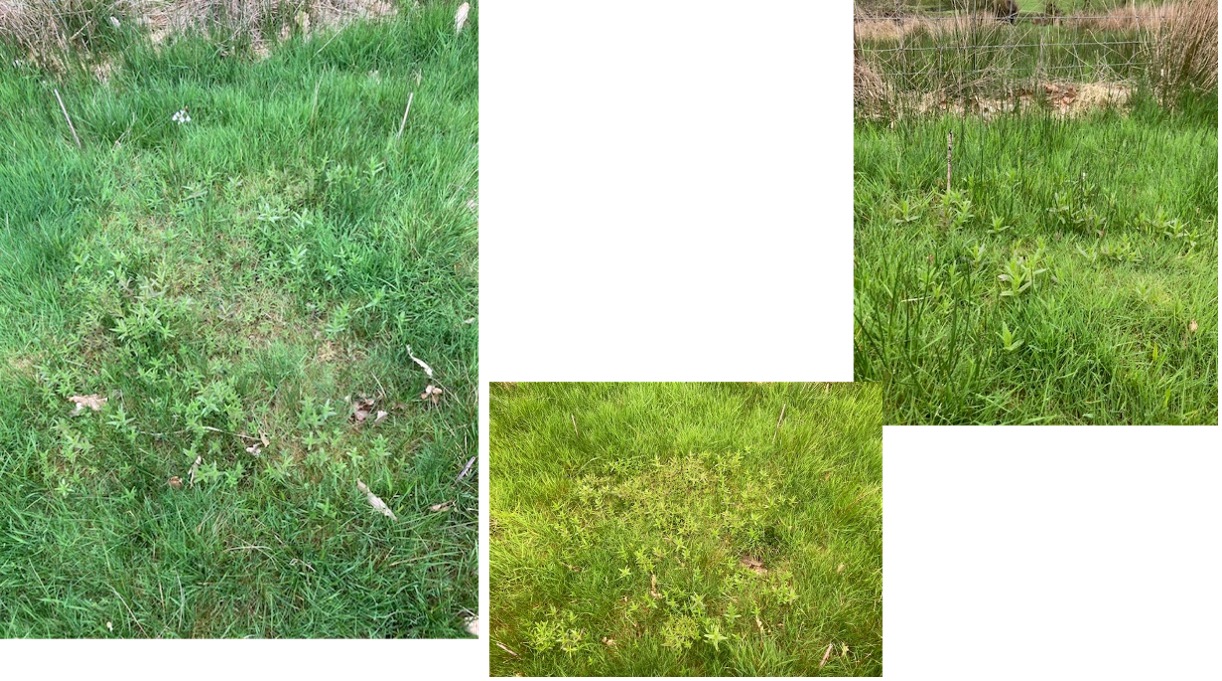
Some fencing was put up to stop the sheep eating the results of the trial. The Yellow Rattle grew well in all the plots, and this is interesting because the advice often given about Yellow Rattle is that the seeds must fall onto bare soil to germinate, implying that they have to be sown on poached or bare ground – we have found that this isn’t the case. They do have to be in contact with the soil, but that’s still possible in the presence of grasses and other plants. As an annual plant, Yellow Rattle will only appear from seed germination in the spring, but this happens every year in hay meadows without bare areas. The presence of livestock to do the aftermath grazing after a hay cut may well help the Yellow Rattle seeds to fall onto the soil surface by treading it in, but this trial has shown that even without being trodden in, enough Yellow Rattle seeds end up falling through a mown or raked sward to contact the soil to ensure plenty of them can germinate.
By 19/06/2023, the Yellow Rattle was seeding well:
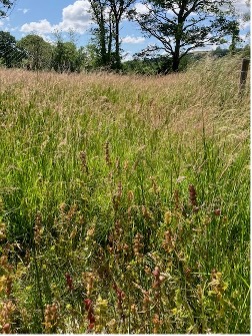

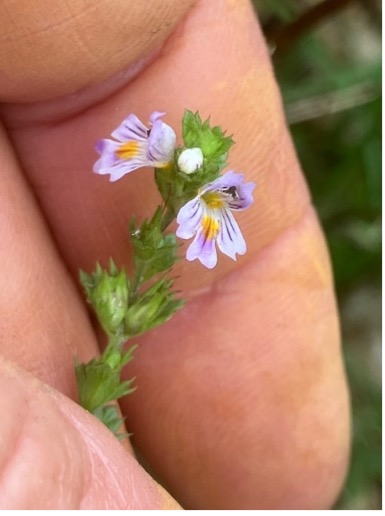
As well as the Yellow Rattle (found in all plots) one of the rotavated plots also contained one plant each of Eyebright, and Lesser Trefoil.
Using a leaf vacuum for seed collection has both advantages and disadvantages compared to other methods. It’s quicker and less effort than collecting seeds by hand, and a leaf vacuum is much cheaper and easier to use than a brush harvester. It also causes less damage to the meadow plants than a wheeled brush harvester or the quad bike needed to tow it. Compared to a brush harvester though, it will not collect as much material – the brush harvester bashes the plants whereas the leaf vacuum probably only collects what is about to drop off anyway. But that also means the material collected (both seeds and chaff) will be dry, as long as the collection is done during dry weather.
The six plots at the recipient site will continue to be monitored., and we have started a second trial with leaf vacuum collected seeds this year, using seed collected in July, and we will report on the results of the new trial next year.
If you might be interested in donating seed from your meadow area, or in receiving some, then please do get in touch with us on this email address: carmarthenshiremeadowsgroup@gmail.com .
 Carmarthenshire Meadows Group - Grŵp Dolydd Sir Gaerfyrddin
Great to see such experimentation and careful observation going on. It’s so important to try out new ideas, especially on wetter grasslands.
I’d love to come and have a look at the test plots next year if possible.
The conservation volunteers at the Botanic Garden tried collecting seed using a handheld Dyson – it worked splendidly, especially with yellow rattle, until he battery ran out (the downside – battery life is very short with Dysons).
LikeLike