
Many thanks to Julian for this update on his trialling of introducing plug plants to his meadows.
————————————————————————————————————
I thought readers might be interested in this post, based on a talk I gave to the CMG meeting last autumn, but updated now with how the plants have changed/grown/failed(!) over this very wet winter.
We’ve been on a long-term project to create more biodiverse, and particularly florally diverse hay meadows on our smallholding for about 11 years, with great success initially by just scattering collected seeds of different plants onto the field after hay was taken from it.
I knew that many of the plants in a traditional old hay meadow had medicinal properties, so it seemed worthwhile introducing these into the remaining meadows rather than the sheep only having access to them as hay or aftermath grazing. Look at just how many of the plants listed below have common, or scientific names, (officinalis) indicating a likely health benefit linked to their consumption, or other medicinal use.
When we decided to create a second flower-rich hay meadow in one of our flat wet valley bottom fields, we started it the same way as the top hay meadow by first hand-picking seeds from our top field and scattering them as well as using bags of green hay.
Progress seemed much faster in this field, probably because of the greater quantities of seed or green hay which we were now able to use.
But two issues still struck me. Firstly, some “special” plants, like devil’s-bit scabious (DBS) and greater burnet seemed very slow to establish in numbers from seeds scattered this way. And secondly, we still had almost none of these plants growing in our other 4 fields which are rotationally grazed by our small flock of Tor Ddu sheep through much of the year.
A couple of years ago, we’d even begun to strew some green hay into our 4 remaining fields, as well as reducing the number of sheep slightly. This is a balancing act since grass growth can change dramatically from one year to another. But despite regular grazing, this year we’ve seen at least some signs of success in that both eyebright and yellow rattle were germinating, flowering and just about setting some seeds in these summer grazed fields. And we do have the nationally quite rare ivy-leaved bellflower, Hesperocodon hederaceus, synonym Wahlenbergia hederacea, growing exclusively in one of these fields, i spite of the summer grazing.
The DBS plug plants I’d planted out in late spring last year established well, but I noticed how slugs love DBS – particularly at the first dicotyledon leaf stage. If you lose the first two seedling leaves of any dicotyledenous plant, before the first true leaves have emerged, then the plant’s probably going to die at this early stage. As well as slugs other things are partial to young seedlings, will take them out and drastically reduce survival rates. Last autumn my seedling Daphne bholua, (a lovely winter flowering garden shrub), despite being a supposedly very toxic garden plant, was ravaged by mice which chomped them all off to get at the pea-like endosperm. All but two of those sown in the ground were trashed. Fortunately, the ones in root trainers could be moved up onto one of our IBC tanks and out of harm’s way.
Last year’s efforts with meadow plants also made me realise what a pain it is trying to make a hole in turf to plant out a 9cm square small plant. This led me to try root trainers once I’d found a British manufacturer of root trainers that were made of recycled plastic and sturdy enough for repeat use. The root systems develop very well, so the plants have a great start when planted out. But most importantly, these plug plants can be planted really quickly and easily using a digging bar or Pottipukti to make the hole, rather than mucking about kneeling with a trowel or spade.
Last year, I’d used our own homemade compost for filling the pots and sowing, but this meant quite a bit of hand-weeding of unwanted plants, as the young plants grew away, so this autumn, I’ve made some tweaks.
Firstly, I’ve used slightly smaller root trainers, which means less compost per plant, and 60 per tray rather than 45, with the same footprint. These are 13 cm deep, and have a volume of about 125 cc – way bigger than a typical “Jumbo” plug.
Secondly, I’ve used our own molehill soil, which we collect annually and store in big bags, sometimes with a layer of leaves at the base. So there’s no buying-in of material, and it’s also much more likely to contain local micro-organisms and local fungi than any bought-in compost, or indeed bought-in plug plants. It also retains water much better than most bought “green” composts. This is important since you’re not going to be able to get around and water your plug plants in a meadow location very easily, once they’ve been planted out. I read on one meadow plant plug-selling site that they recommended watering their plugs 4 x daily! Hardly practical for many projects. I hand-sieve the soil into the root-trainers.
The saved molehill soil is remarkably free of stones. The manually collected seed is sown fairly thinly onto the surface, but not individually since I was still unsure about the germination rates of the various species. And finally, the seed was covered with a very light sprinkling of our rotted-down log compost.
I was amazed by how many species germinated in less than 14 days, and also how relatively weed-free the molehill soil seems to be. (Most of it came from a grazed field, not one set aside for hay). Plus any “weeds” which do emerge will mainly be meadow plants anyway, so other than being competitors for special plants, not a huge issue. I’ll probably water them with some diluted worm juice from our wormeries next spring to give them a boost, which helped the last batch.
However, even in this relatively controlled environment with some limited judicious use of “organic” ferric phosphate slug pellets, there are still signs of how even numerous, tough, more common seedlings have been nibbled and taken out by small slugs.
Once the plugs have rooted well enough to be pulled/pushed out – which will vary in time from one to another, they’ll get planted out during any of our rare wet spells (?) into our 4 summer grazed fields. I’m sure this won’t be an annual task, certainly not on this scale, since there’s going to be a lot of effort getting so many plugs into the fields.
Should any readers be interested in getting some plugs to try on their own site, I’d suggest you get in touch before mid-May. The species I’ve sown so far. are listed below.
Of these, the ones highlighted in bold had already germinated in the autumn by September 20th.
Pignut, Conopodium majus(spring germinating)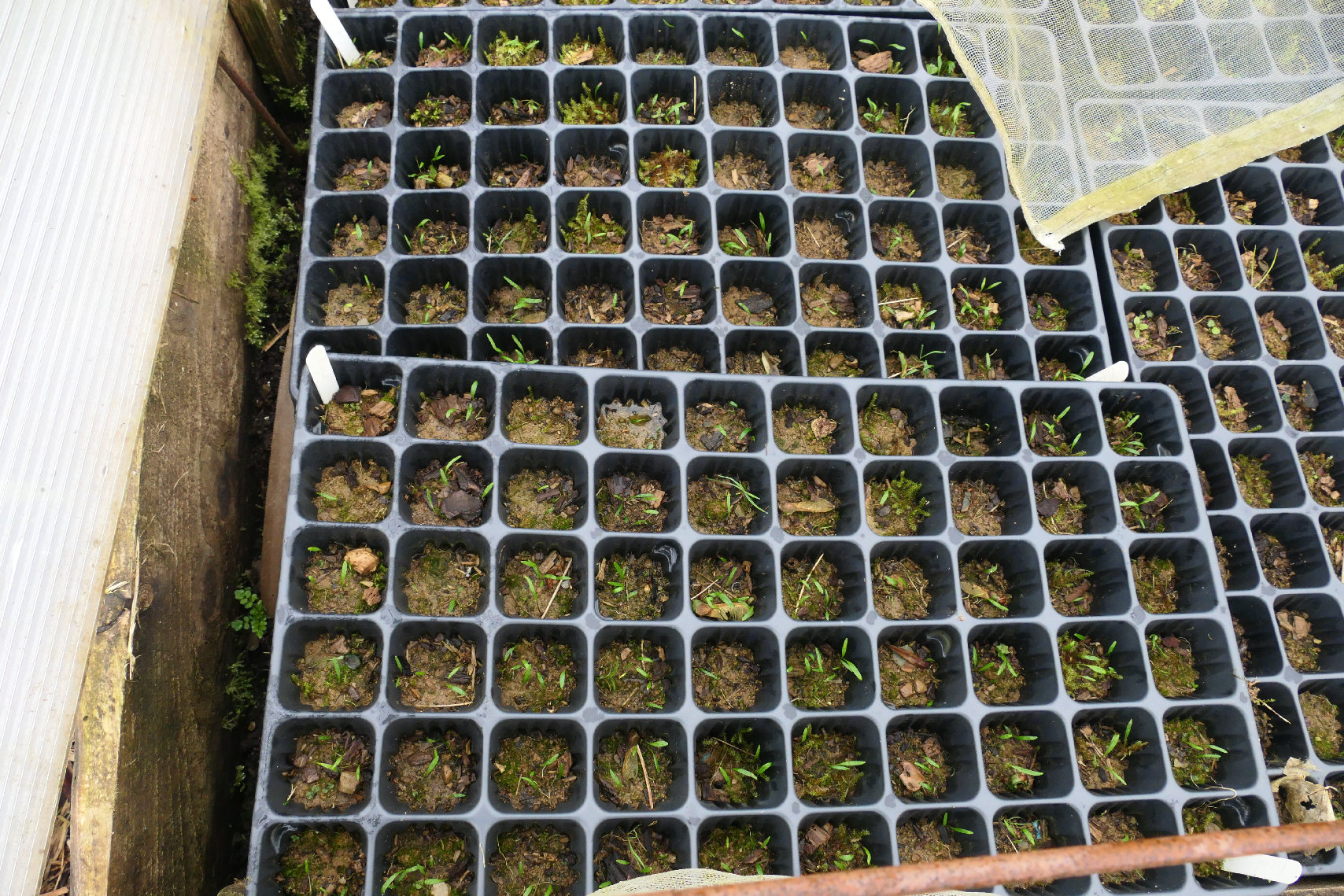
Valerian, Valeriana officinalis
Yellow rattle, Rhinanthus minor, with Common Bent, Agrostis capillaris
Eyebright, Euphrasia nemorosa, with Common Bent, Agrostis capillaris
Betony, Stachys officianalis
Cowslip, Primula veris
Angelica, Angelica sylvestris
Self-heal, Prunella vulgairs
Lesser Spearwort, Ranunculus flammula
Bird’s-foot Trefoil, Lotus corniculatus
Tormentil, Potentilla erecta
Meadow Cranesbill, Geranium pratensis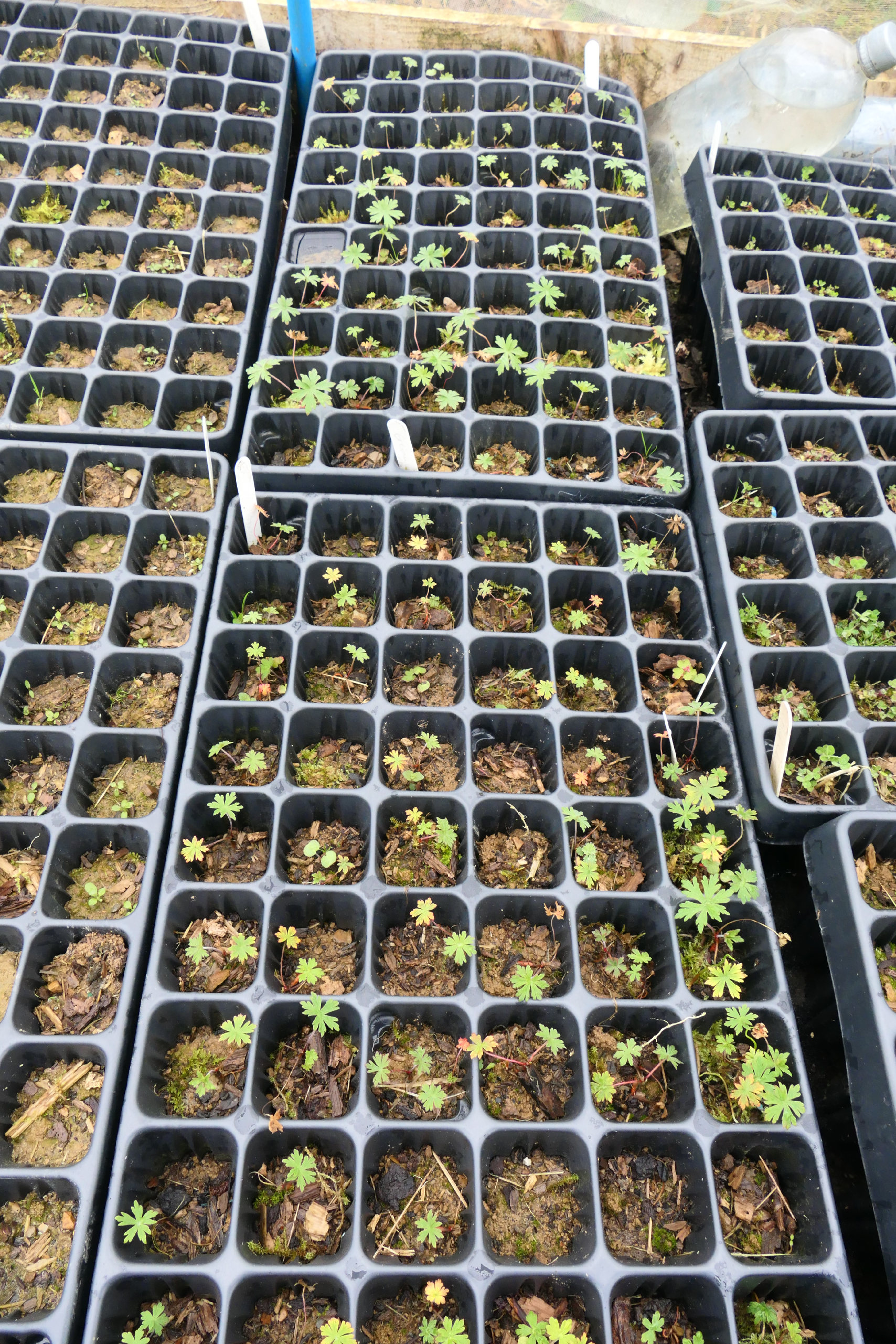
Greater Burnet, Sanguisorba officinalis
Melancholy Thistle, Cirsium heterophyllum
Fox and Cubs, Pilosella aurantiaca
Ribwort Plantain, Plantago lanceolata
Sorrel, Rumex acetosa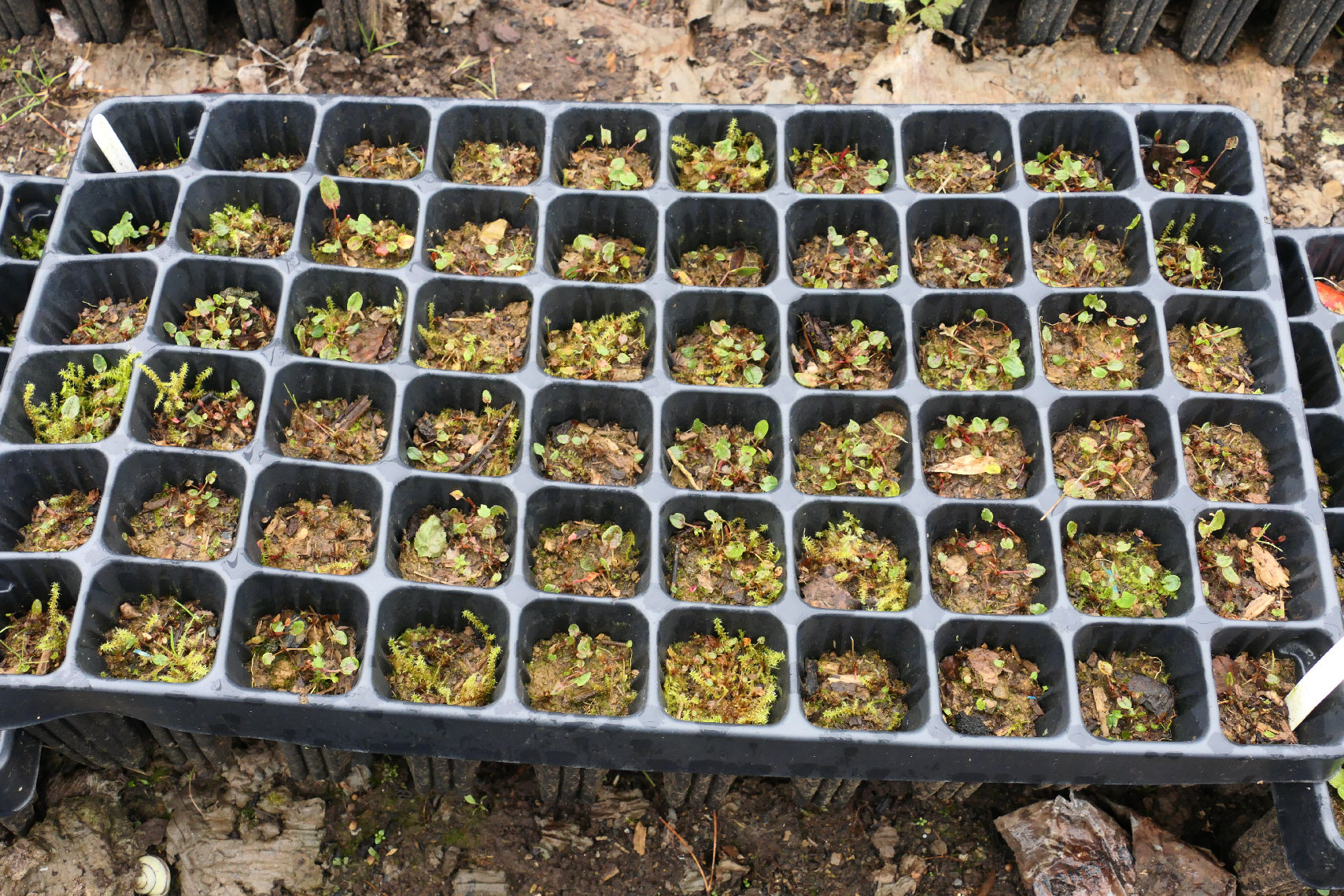
Knapweed, Centaurea nigra
Cat’s Ear, Hypochaeris radicata
Devil’s-bit Scabious early form blue, Succisa pratensis
Devil’s-bit Scabious late form blue, Succisa pratensis
Devil’s-bit Scabious late form pink, Succisa pratensis
Meadow buttercup, Ranunculus acris
Red Clover, Trifolium pratense
So, how have they fared over winter and up to mid-April 2024?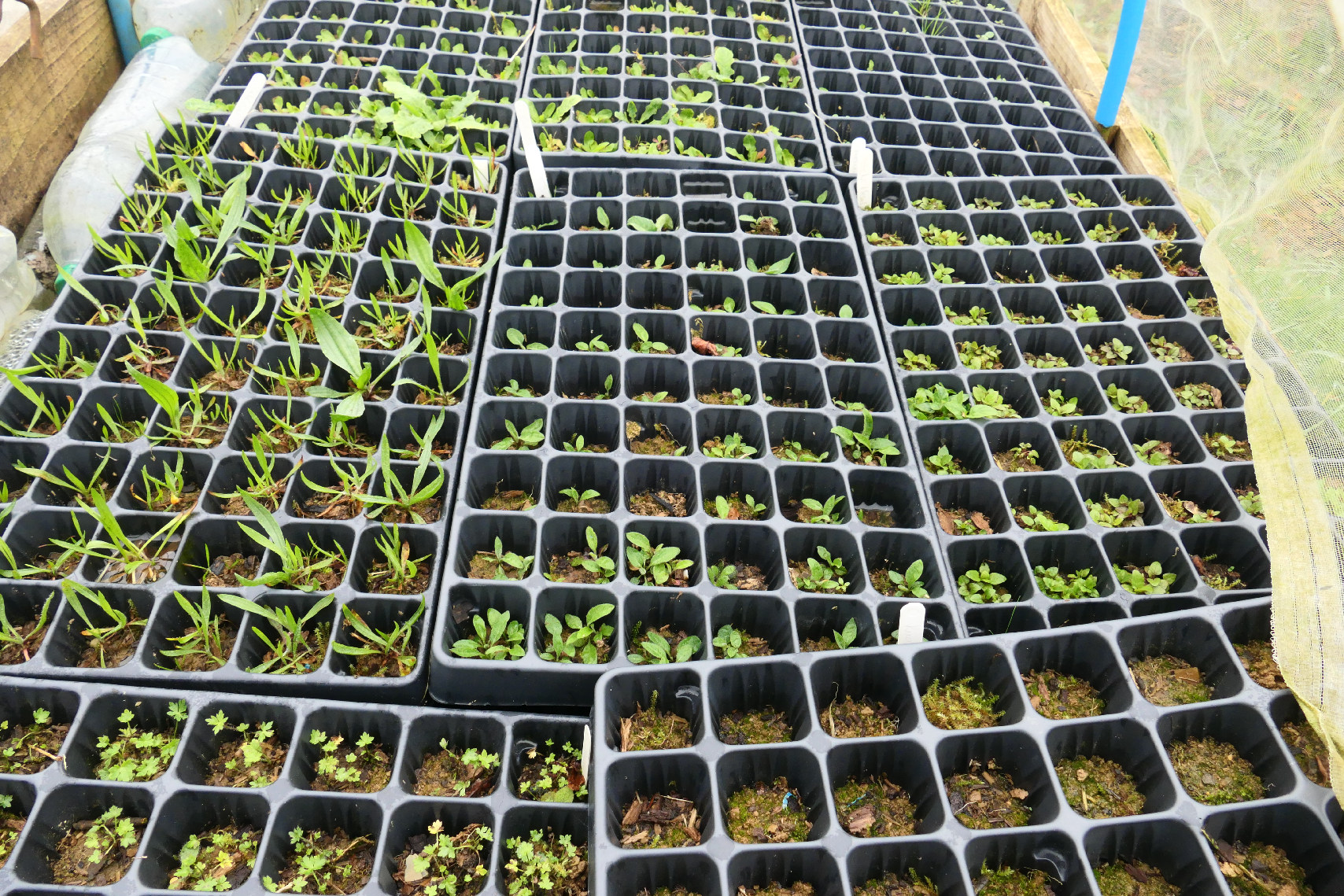
(Ribwort plantain and selfheal above)
We all know that the weather has been persistently wet, dull and generally mild. For the record, we’ve had 1782 mm of rainfall here in the 7 months from September to March (more than we used to get in a year, on average). And another 173 mm in the first 18 days of April. These seeds/lings have had a real pasting, in grotty molehill soil!
There have been many days when most of the root trainers have had standing water in them for days on end. Some plugs must have had a stone impeding drainage completely and nothing has survived in some of these. Some trays have been left out in the open, although many have been overwintered beneath a simple hooped cover of enviromesh, which will have given some slight protection from strong winds, in an exposed site, and a degree of temperature protection on those rare cold nights.
There have been few losses, apart from cowslips, which seem to have failed after very late germination. Bird’s foot-trefoil has germinated patchily and poorly, ( I felt the seeds were very small when I’d collected them), greater burnet patchily, and lesser sorrel hardly at all. Although I was suspicious that I possibly had collected seed heads before the seeds had matured fully for these. The common sorrel seems to have been knocked back quite a bit over the winter.
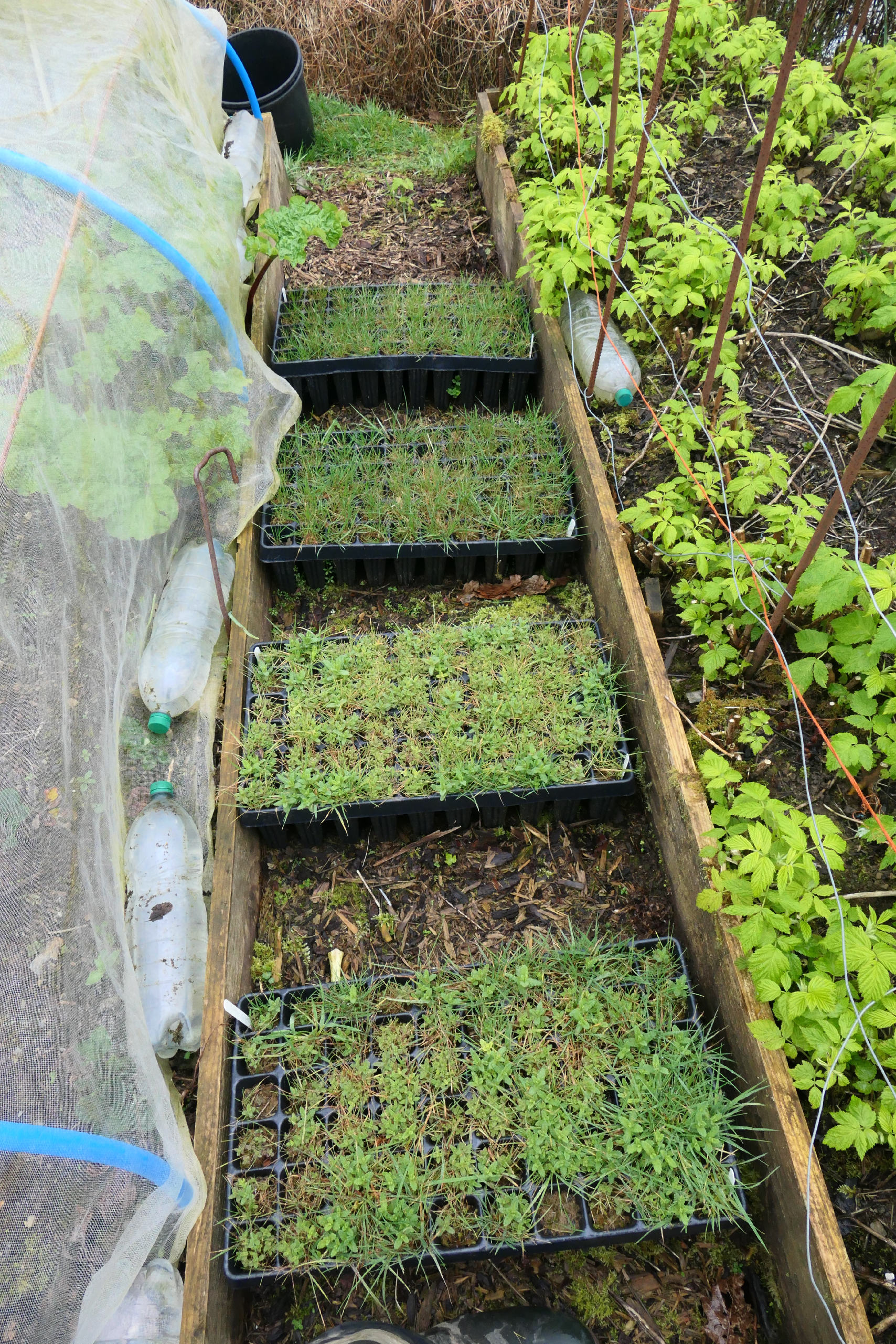
The 2 hemiparasitic species – yellow rattle and eyebright, which were sown into root trainers along with collected seed of common/creeping bent grass, have both germinated in the spring, with the eyebright still being at a very small size in mid-April.
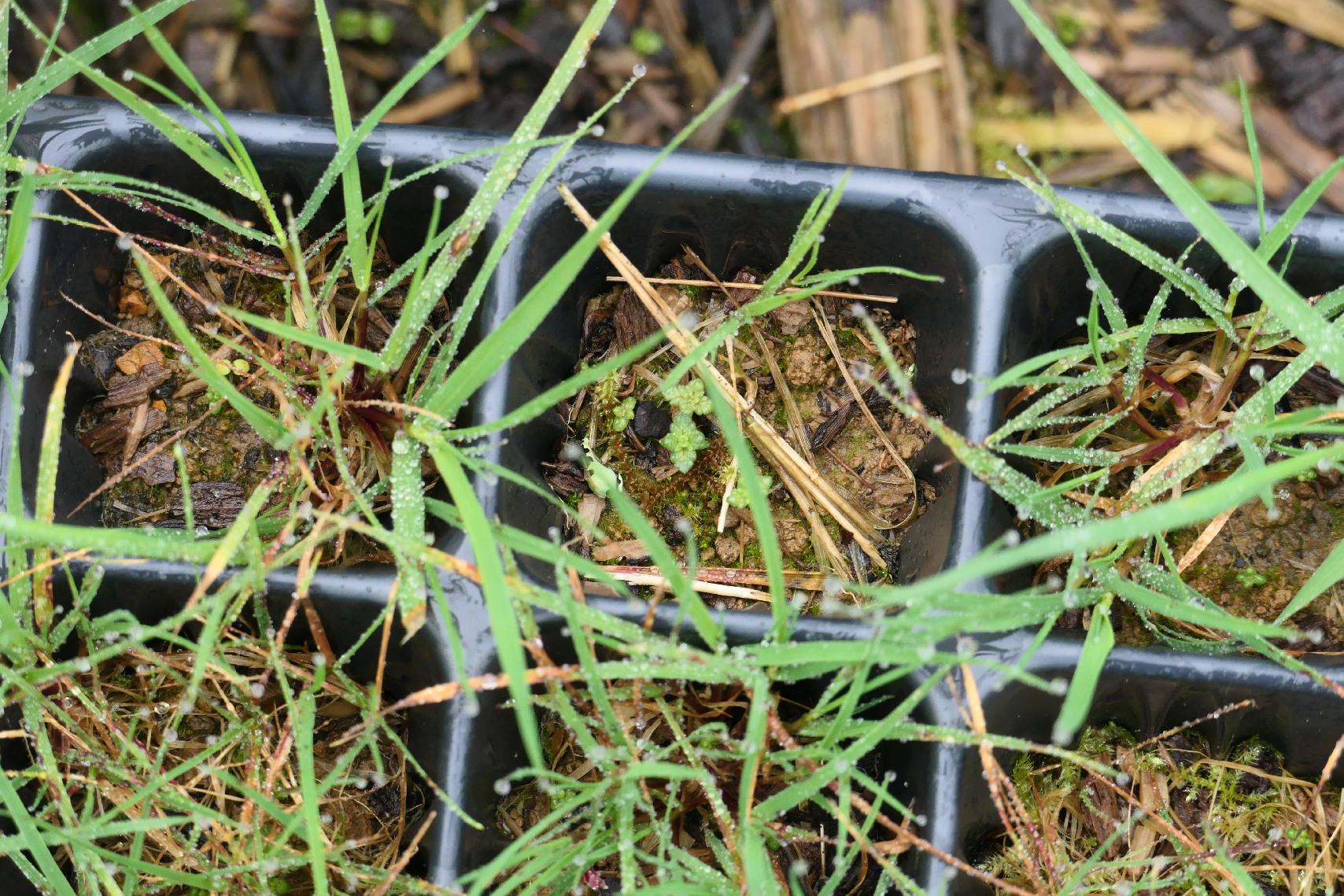
The yellow rattle is already visibly knocking the grass seedlings back.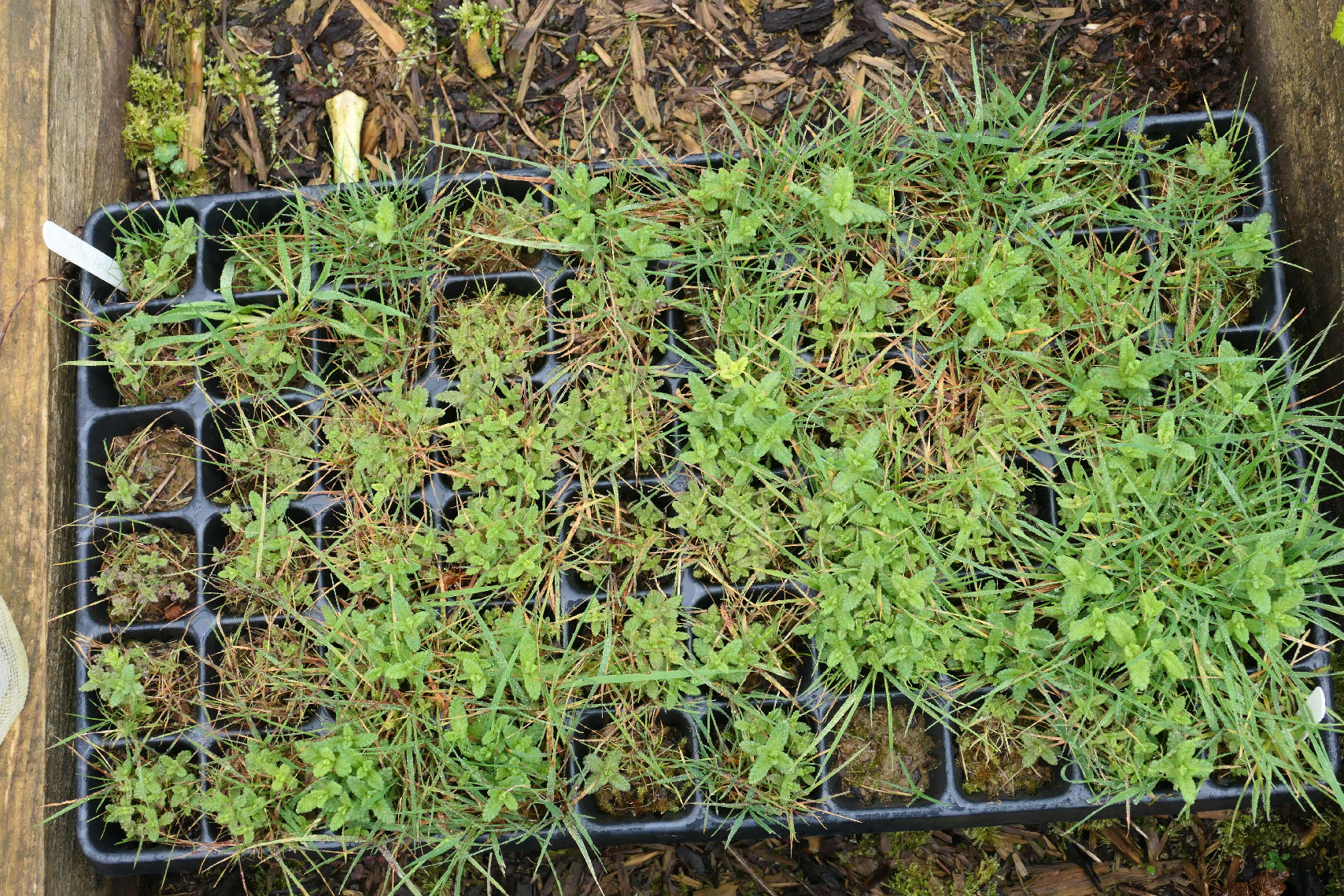
These grass/hemiparasitic plugs will probably be the first to reach a size where they can be planted out. The ground is certainly wet enough! We really need a bit more warmth and sunshine first, I think, to get them a bit stronger, with root systems that reach down to the base of their containers.
So in summary, this has proved to be a fairly simple low-cost way of building up numbers of many of our common meadow plants, to a point where they’re more likely to get a head start and survive if planted out into to an area of field or grass with little current diversity.
.
 Carmarthenshire Meadows Group - Grŵp Dolydd Sir Gaerfyrddin