Andrew Martin comments:
There has been an interesting discussion on the CMG Facebook Group about late hay cutting. If your main priority is to get maximum floral diversity in the meadow (rather than the best hay crop), then cutting later will allow more species to finish flowering and drop their seeds. The two small fields managed as hay meadows here (about 1 acre each) have had increasing numbers of Southern Marsh, Common Spotted and Heath Spotted Orchids over the years since the first Orchid (a Southern Marsh) appeared in 2017. The flower spikes lose their petals mid-July to early August, but the seed capsules remain green and moist for a lot longer. When ready and viable, orchid seeds are like cocoa powder – a brown dust, they are tiny as they don’t contain stored food like most seeds; they germinate when they land on soil but they have to find the appropriate fungus with which their roots can form a mycorrhizal association – if they don’t, they just die. The fact that there are now over 100 orchids in these two fields is good evidence that they haven’t been treated with artificial fertilizers in the past. Another species that is late to finish flowering and drop seeds is Common Knapweed which, like many purple-flowered Asteraceae, is used extensively for forage by Bumblebees and other pollinators.
Since starting to manage the fields as hay meadows (one in 2014 and the other in 2016) the hay cut has been done in August in order to allow these late-seeding plants to drop their seeds. Most years, there have been the necessary number of consecutive dry days to do the hay cut (day one), turn the hay twice on day 2 and late morning of day 3, put it into windrows in the afternoon of day 3, and bale it on day 4. The baling is done using a mini round baler:
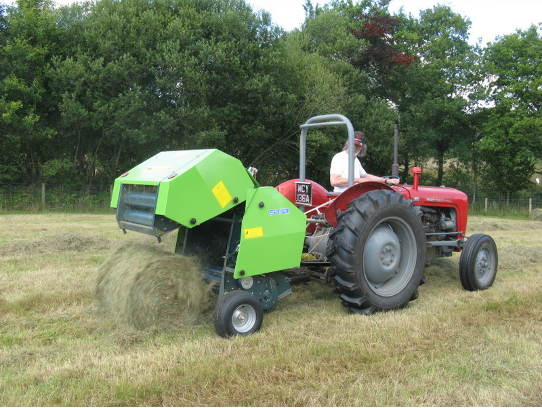
and because the bales are often not sufficiently dry to store as hay, they are wrapped using a small wrapping machine, to produce haylage:
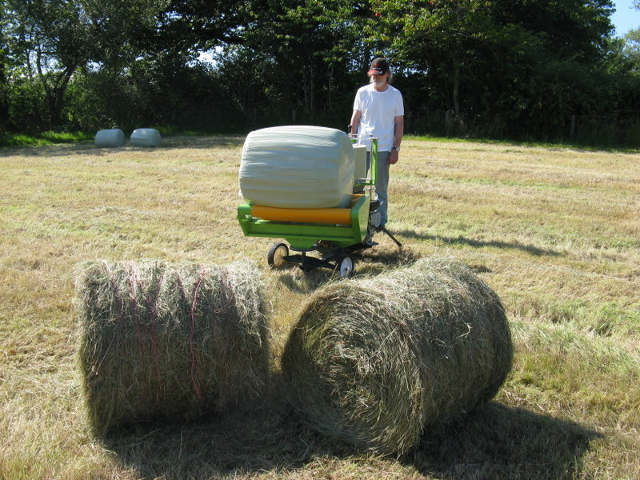
This has the added advantage (as the rain clouds gather) that the bales do not have to be stored under cover.
Most years this has worked well; but in 2020 it did not. Other work meant the hay cut couldn’t be done in early August, and then big storms and heavy rain arrived. The ground became so wet it would have not allowed the hay to dry enough – the mini baler can manage grass that’s not dry but if the water content is too high the grass will hang together too much and become wrapped round the rollers in the baler, so bringing it to a stop. Instead of the hay cut, 21 sheep were brought in to eat their way through the meadows – they were owned by the usual buyer of the haylage so they got to eat the fields before baling rather than later in the winter. They ate virtually everything apart from dead brown Knapweed stems.
Last year (2023), August was too wet to do the hay cut. But the first week of September was hot and rain-free. So, some of us in CMG decided to do the hay cut then. If you attended our Spring meeting this year, you’ll have heard Laura Moss’s talk on the traumatic time she spent haymaking in September. Here, I cut the fields as normal, did the hay turning as normal, but found that half of each field was in the shade for much of the day due to the low position of the sun in the sky; and that was in addition to the short day length – under 6 hours of sun per day compared to nearly 8 in July. Part of each field could be baled as normal, but because the small fields are bounded by tall treelines the rest would not dry at all, it was still like fresh cut hay after being turned several times because it was in the shade and the dew didn’t evaporate from it. But having cut the field, the cuttings had to be removed somehow, so it ended up being loaded into a trailer and taken to the local tip for composting in quite a lot of trailer loads. Most of us who did the hay cut in September have resolved not to try it again.
The weather forecast for the rest of August and the beginning of September this year does not look good; so the sheep will be coming back again. The weather definitely seems to be more unpredictable and less reliable than it used to be, and with average global temperatures being higher than they were, it’s inevitable that there will be more water in the atmosphere, and some of it is going to fall out onto our meadows, when we don’t want it to.
Now the Orchids and Knapweed are well established, and they are perennial plants, in future years the hay cut will be done in July, when the day length is longer and the sun is higher. Hopefully there will be a better chance of getting 4 or 5 consecutive dry days in July than in August.
For some interesting contributions to this discussion, including successful September hay cutting, effects of timing of hay cuts on Waxcap fungi, cutting part of the hay early and part late, have a look on the CMG Facebook group: https://www.facebook.com/groups/419022235103533/ .
 Carmarthenshire Meadows Group - Grŵp Dolydd Sir Gaerfyrddin