By Andrew Martin, Isabel Macho and Laura Moss
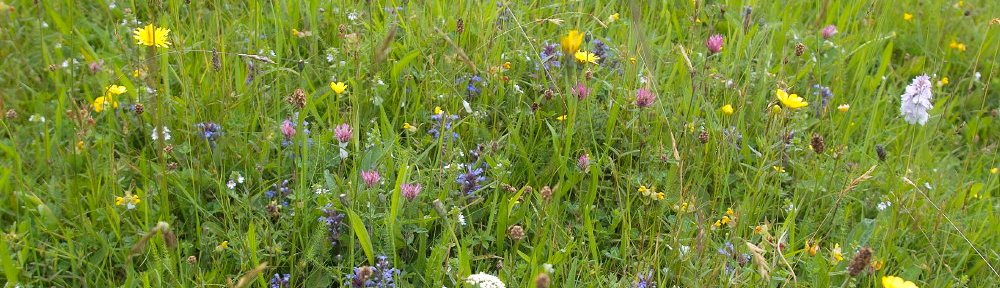
Flower-rich meadows evoke a quintessential image of the UK countryside in summer. However, in reality, they have nearly all disappeared. In the west of the UK, and in Carmarthenshire in particular, grassland predominates but most of it is agriculturally “improved”; the meadows have nearly all gone. There was a decline of 97% in the area of farmland they occupy between 1930 and 19841. This figure was calculated from agricultural censuses and records for counties in England and Wales, and this exercise has not been recently repeated, and it doesn’t include land owned/managed by small scale landowners, nature reserves, etc. So, although the current area of flower rich meadows is not precisely known, the scale of the loss is huge and it is not only the loss of an attractive feature of the landscape; meadows also provide a habitat for many species of specialised plants, animals and fungi, so they too have rapidly disappeared from much of the countryside. The meadows that remain are often small and isolated from each other – which is one reason why Carmarthenshire Meadows Group (CMG) needs to know where they are (see “The Nature Emergency – how meadow owners can help). They are one of the UK’s most threatened semi-natural habitats, and their restoration and enhancement is therefore a conservation priority.
What exactly are meadows?
When humans developed from being hunter/gatherers and began farming and keeping livestock, winter feed for their grazing animals was provided by foliage from stored brushwood cut from trees earlier in the year. Humans started cutting grass for hay as winter feed after the invention of metal grass-cutting blades in the Iron Age. Since then, land was set aside for hay production, and a field used to grow hay for winter feed is known as a meadow. Such fields are closed to livestock in spring and allowed to grow, without grazing, until they are cut for hay in the summer. Once cut, and the hay removed, the grass continues to grow and the ‘aftermath’ can be grazed by livestock into the autumn. This is the strict definition of the term ‘meadow’, but it is also used to refer to species-rich pasture whose floral diversity is maintained by controlled low-density grazing. Until the mid 20th century, oxen or horses were used for transport and traction in the countryside, and every farm needed hay as winter feed for them as well as livestock. In towns and cities where grazing land was not available nearby, considerable quantities of hay were needed to feed all the horses used for horse-drawn transport, and it was produced in hay meadows surrounding the cities. As cities grew during the industrial revolution in the 19th century, more hay was needed to fuel horse-powered transport, and more land, managed as hay meadow, was being used to provide it, reaching a maximum in the early 1900s.
Why have meadows disappeared?
During the early 20th century, farming and transport became mechanised. Horses were replaced by tractors, lorries, buses and cars which ran on oil rather than hay. The UK population grew massively in the 19th and 20th centuries, from 10.4 million in 1821 to 35.2 million in 1921 and 69 million today. Much of the nation’s food was imported from Britain’s overseas colonies. As the population continued to grow, and especially after wartime U-boat attacks on convoys carrying food, there was concern that the UK was too dependent on food imports, and there was a major effort to increase food production. During and after the Second World War, agriculturally marginal land was ploughed up and put into cultivation, and much research effort was focused on increasing the efficiency of farming. This was achieved by the introduction of more sophisticated technology, selective breeding of new varieties of crop plants and livestock, and the development and use of pesticides and artificial fertilisers. For example, a modern wheat field produces about 8 tonnes of grain per hectare2, compared with about 2.2 tonnes a century ago3. In the 1940s, the average milk yield of a dairy cow in the UK was about 2,500 litres per year. By the 1990s this had increased to 5,000 litres per cow per year, and today it is about 7,500 litres, with some herds even producing 10,000 litres.4 To produce this much milk, dairy cows need high-energy food. Although many traditional meadows survived until the inter-war years, by the late 20th century, they had been almost completely replaced by highly productive and fertilised grass leys which could be cut several times per year to produce silage. Silage has higher protein and energy content than hay, so more livestock feed could be produced from the same area.
This huge increase in productivity in all branches of agriculture has been at the cost of a great loss of biodiversity in the countryside. Much of the wildlife associated with farmland, adapted to habitats that had remained much the same over a couple of thousand years, has been unable to survive the rapid rate of change in the farmed environment during the last half-century. Many species have declined or disappeared within living memory; not only the plants and animals that are obvious to us, but also soil organisms on which much of the native surface flora depends. In the agriculturally improved grasslands of today, most of the plants, animals and fungi that thrived in traditional meadows, once ubiquitous in the countryside, have gone. Traditional meadows are no longer part of commercial farming.5 However, those that remain can still provide species-rich hay or haylage which, although lower in protein and energy content than modern silage, is a much more complex mix of grasses and herbs. There is some evidence that the non-grass content can benefit livestock in ways other than basic nutrition6, so hay meadows can still provide a useful source of winter feed for many traditional (and some modern) breeds of livestock.
Meadow management today
Of the meadows that remain, some are in agri-environment schemes, some are nature reserves managed for biodiversity and are owned or managed by conservation organisations (local and national), and some are owned and managed by small-scale private landowners. It doesn’t matter if your meadow is a small patch in the garden, a 5-acre field, or if you don’t yet have your own meadow; if you are interested in meadows you can benefit from joining a group where you can share knowledge and experience on grassland management with others who are seeking solutions to the same problems, and wish to protect and enhance biodiversity on their land. Meadows Groups, therefore, exist to help interested landowners and land managers to conserve, restore and enhance species-rich grassland and its associated wildlife.
The website section “Meadow Creation/Conservation and Management” lists links to a wide range of practical advice and information.
Thanks for reading.
- Fuller, R.M. (1987) The changing extent and conservation interest of lowland grasslands in England and Wales: a review of grassland surveys 1930-1984.Biological Conservation 40: 281-300 ↩︎
- DEFRA: https://www.gov.uk/government/…/structure-june-ukcerealoilseed-21dec2017.xls ↩︎
- Brassley, P. (2000) Output and technical change in twentieth-century British Agriculture. The Agricultural History Review 48, 1, 68–84. ↩︎
- Agriculture and Horticulture Development Board: https://dairy.ahdb.org.uk/resources-library/technical-information/breeding-genetics/breedingplus-section-1-improving-through-breeding/#.W8HWRvZRfIU ↩︎
- Peterken, G. (2013) Meadows. British Wildlife Publishing. ↩︎
- Shellswell, C.H. (2017) Is the rye-grass always greener? An evidence review of the nutritional, medicinal and production value of species-rich grassland. Plantlife. https://floodplainmeadows.org.uk/sites/default/files/resources/Is_the_rye-grass_always_greener_An_evidence_review.pdf ↩︎
 Carmarthenshire Meadows Group - Grŵp Dolydd Sir Gaerfyrddin