We’re heading into the quiet time of the year for meadow activity (at least visibly above ground), but there’s been a lot of activity behind the scenes in the meadow group, leading up to a planning meeting of what we’re calling a steering group, which we hope will lead to further group developments for next year. Watch this space for more news in the near future. And if you’re not already following this website, then do click on the follow button, which will ensure that you get regular updates of any meadow group news as soon as they are published.
We’re very fortunate in having a diverse range of people volunteering to meet to discuss the group’s progress. One of whom, Andrew Martin, has a background including research into bumblebees. Indeed we hope Andrew will be able to talk to the group in the spring to share some of his considerable knowledge on this subject.
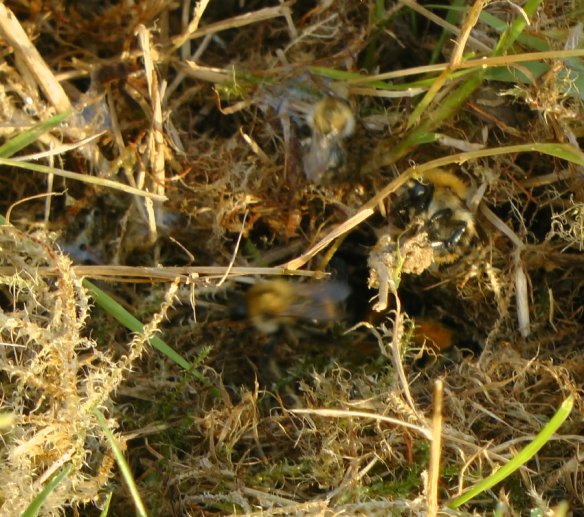
Personally I struggle with bumblebee identification, though over the years, I’ve occasionally found a couple of nests around the garden. But this year, in mid August, after cutting another section of the meadow with the powerscythe, up to the narrow steep, and south facing bank running across a part of our hay meadow, I was suddenly aware of a number of bumblebees milling around the cut grass towards the base of the bank. I reckoned they were Bombus pascuorum, and whilst I hadn’t fortunately destroyed the nest, the bees were clearly disorientated and struggling to find their tunnels through the long grass which led into the nest. After shifting the worst of the cut grass from the area, order was soon restored, and the bees soon returned to normal activities.
However about a fortnight later disaster struck, in the form of a nocturnal ripping up of much of the nest structure, exposing the irregular clusters of large cells, with a melee of bees of several sizes all working, apparently aimlessly – though obviously not, since within 24 hours a new mossy covering had been created and the cells were hidden.  I figured that the colony probably wouldn’t be viable, so did nothing more – and then discovered the bees kept visiting the nest. Until a couple of weeks later the nest was trashed again.
  This time in constant drizzle, the bees worked again for 36 hours, with a rather bedraggled queen bee obvious amongst them, and (belatedly!) I covered the site with a metal rack weighed down with tyres.
 This worked and the bees kept visiting the site right up to early November frosts, when the last workers would have probably died.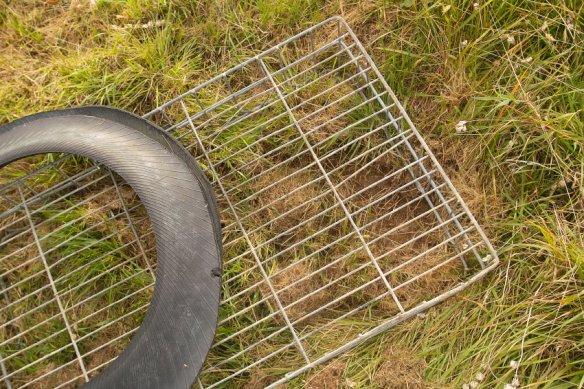
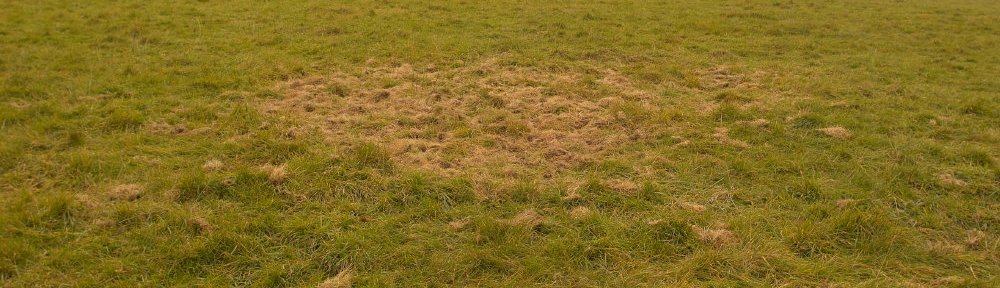
I suspected the damage had been done by a fox, since they have well worn trails through this field. However in early October, I discovered something not seen before on our land. Overnight, about 15 metres away from the bumblebee nest, a roughly circular area of turf about 4 metres across had been systematically ripped up. Deep, large upturned clods of turf littered the ground. It hasn’t been repeated elsewhere in the fields since, or revisited.
But the question is what caused this? Badgers seem most likely to be responsible. Our neighbour has badgers on his land, but we’ve never seen any, or specific damage before. Has anyone else ever had such damage in their fields? And if so only in the autumn ?
The other issue is what they were after. The principle diet item for most badgers is earthworms, but they are omnivorous, and will eat fruit, grubs and fungi, particularly in the autumn. And worms are often on/at the surface at night time. Since the damaged area is in a roughly circular pattern, and since slightly later than when the damage occurred, many Liberty cap mushrooms ( Psilocybe semilanceata) popped up around our fields, I’m fancifully speculating that it was a badger with a penchant for Class A narcotics. 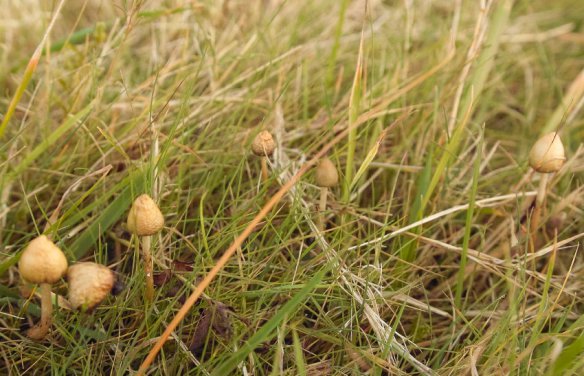 Which could sniff out the forming mushrooms beneath the ground? Whether badgers would experience the reported visual psychedelic effects associated with psilocybin intake in humans will no doubt remain a mystery. And indeed this damage may have nothing at all to do with mushrooms!
Any thoughts about this anyone? Informed or fanciful.
Thanks for reading
 Carmarthenshire Meadows Group - Grŵp Dolydd Sir Gaerfyrddin
Julian,
We get this in a number of our hay fields and in our orchard annuallly, though not in the same place. We are fairly sure it is badgers, and one day will aim to see then rootling about by baiting a newly dug area with peanuts.Foxes , and unsurprisingly green woodpeckers, go for our anthills more.
Charles & Mo Morgan
Wenallt
LikeLike
Thanks Charles and Mo. It’ll be interesting to see just how widespread this is ….I wonder if you’ve noticed it at particular times of the year, or throughout all seasons?
best wishes
Julian
LikeLike
We’ve had the same under the bird feeder when all the turf was ripped up and clods of earth spread everywhere. It happened in the autumn/winter and there are badgers locally. Indeed there was one crossing the road nearby just last week. Hope it comes back!
LikeLike
Thanks Marianne. Apparently they’re very partial to peanuts …best wishes
Julian
LikeLike
We’ve had this in our orchid-rich hay meadow at the Botanic Garden. It is badgers and they’re likely to be after cockchafer beetle larvae – these grow to be fat, juicy and 4cm long and provide a good meal during the winter months. The badgers made what looked like a real mess on our meadow but really, all was well the next year and hey, that’s nature.
LikeLike
Thanks for that Bruce, even if it does spoil my magic mushroom theory. Mind you I’ve just looked up cockchafer life cycles, etc. which seem to merit writing about sometime.
Best wishes
Julian
LikeLike
I have had badgers for several years grubbing up the drier slopes of a dry field leading down to the river in late August and September. They have only come since the bracken brambles etc have been cleared from this field. This year I saw swarming of garden cockchafers in July favouring this area with its native grasses. I believe the badgers can easily dig up this short turf to get at the grubs. They disturb the same area each year so the sward is fragile.
LikeLike
Thanks Ruth for this interesting insight – maybe we’ll have them returning next year then – its certainly as in your case one of the drier bits of field on our property,
best wishes
Julian
LikeLike