The two meadows at our place (each about 1 acre) have been managed as hay meadows now for 12 and 10 years respectively. Each year I’ve been leaving the hay cut as late as I dare, because although the best hay would be obtained by cutting sooner, I wanted to give some of the plants (especially the Orchids – there are Southern Marsh, Heath Spotted and Common Spotted) time to produce viable seeds. The petals fall off in late June/early July, but the seed heads stay green for a long time after that while the seeds (like cocoa powder) develop. So, most years the hay cut has been done in August, and one year even the first week in September. Laura Moss and I both decided to give our haymaking a go in early September 2023 after a very wet August. A dry week seemed too good a chance to pass up. Anyone who heard Laura’s talk at the Spring 2024 CMG meeting will know why neither of us is going to try that again! The problem is not only the various bits of bad luck and machinery failures that Laura told us about, it’s also that the much shorter days and low position in the sky of the sun meant that in my meadows, half of each field was in the shade almost all day. It wasn’t possible to get the hay dry enough to bale. I ended up having to take it by trailer to the tip so it could be composted there.
So, this year, since the late seeding plants are now so well established (there are now hundreds of Orchids – and Knapweed plants) I decided to do the hay cut in the first dry week in July.
Last year I couldn’t do a hay cut at all. Because of a back injury in mid-June, I couldn’t do any heavy work for several months. A gang of 24 sheep were brought in to eat the meadows off in late summer – I’ve had to do that once before when there weren’t enough consecutive dry days in late summer to do the haymaking. The sheep do a good job; they eat virtually everything except Knapweed stems – maybe a bit too woody by then. But they also do a certain amount of trampling of the sward as well as eating it. That, and a huge amount of rain in the spring are possibly why this summer, both fields had grass much more lush, more tall and denser than in previous years.
I also decided to leave an area of each field uncut until late summer, partly so that the habitat didn’t completely disappear in one day and there would still be some meadow left for all the invertebrates that depend on it, but also because this summer, for the first time ever here, Greater Butterfly Orchids had appeared. They must have been there already (I don’t think they produce flower spikes for a couple of years) but this year there were 14 plants in flower! So, I left that part of the field uncut, and a similar sized area in the other field.
The drum mower did a good job
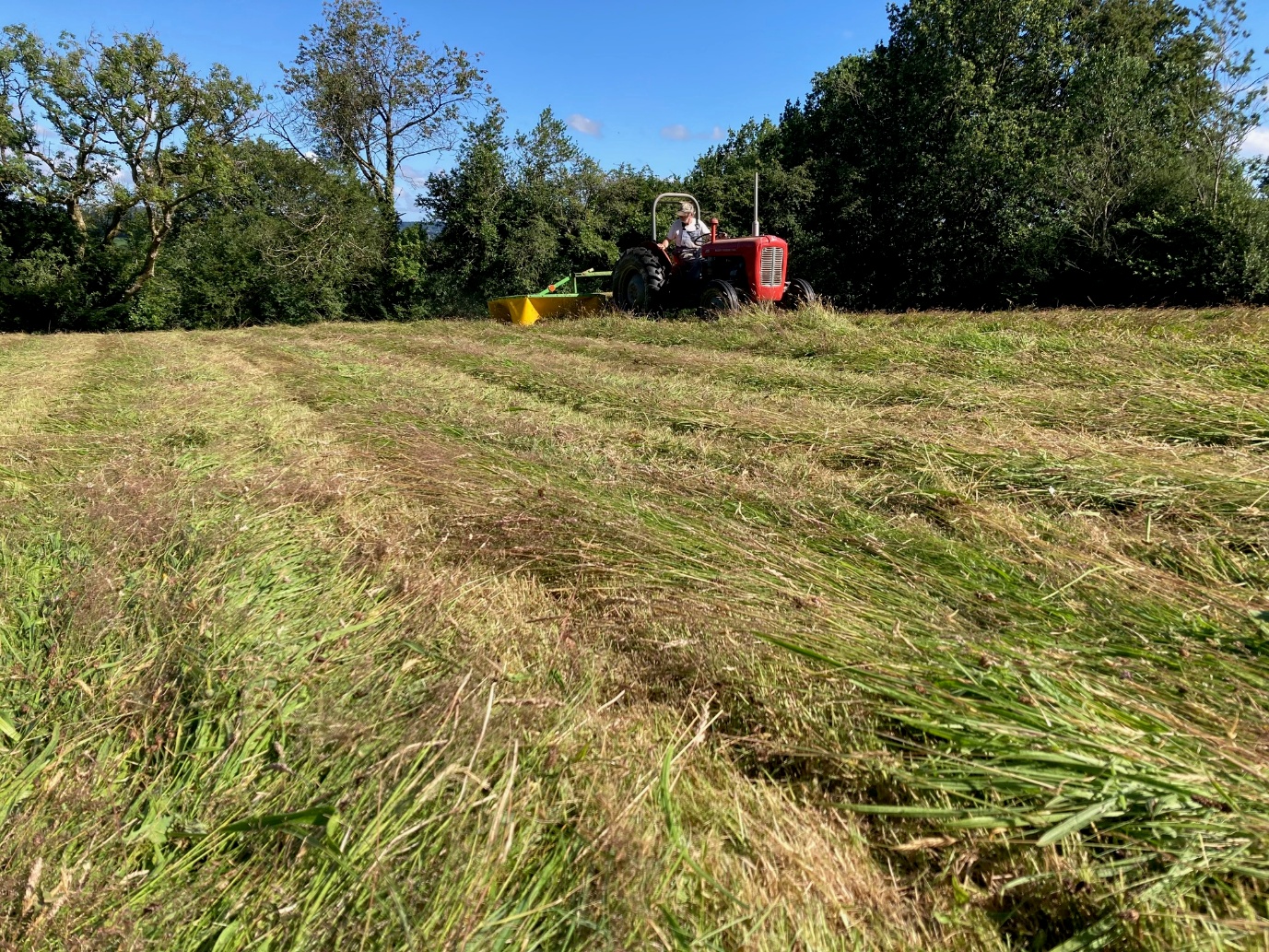
then it was time to start on the tedding.
I use a Haybob (an old one bought locally from eBay) to do the tedding and the rowing up. I had noticed one of the Haybob’s tyres was a bit low, and had pumped them both up to about 24psi. I did 2 lots of tedding the day after cutting, one late morning (when the dew had evaporated) and one late afternoon, and all was well. When I went out to do the same the next day, I checked the tyres and all still seemed well. But, when I’d finished the first session of tedding, I saw that one of the tyres was now completely flat! This matters, because you set up the haybob so that its tines just brush the top of the cut sward. But with one tyre flat, the tines that side were now much lower, and actually scraping the ground and thrashing the cut hay far too much. The tyre now wouldn’t stay up, and worse still, because it had been running while flat, the sidewall had a big split in it – not surprising as the tyres are probably about 50 years old. I tried in various local places but nobody had a tyre or tube to fit. I therefore bought some puncture repair spray that you put in the inner tube which seals the puncture, and then reinflated the tyre. Next day I went out to do another 2 sessions of tedding, but after doing only one lap of the field the tyre burst – the inner tube had burst out through the split in the sidewall. I ordered new tyres and tubes online (might as well replace the other wheel’s tyres and tubes as well while I was at it) and of course had to wait for them to arrive, so no more tedding until they had. To replace the tyres and tubes I had to take the wheels off the haybob, clean up the wheels and paint the inner rims (they were rusty before), then replace the tyres and tubes, and put the wheels back on the haybob. Meanwhile, the unprecedented (since I’ve been here anyway) heat and drought continued, and the hay in most areas of both fields (apart from that in shade from the treelines for part of the day) got a lot drier than it needed to be. By the time I could put the hay into rows ready to bale
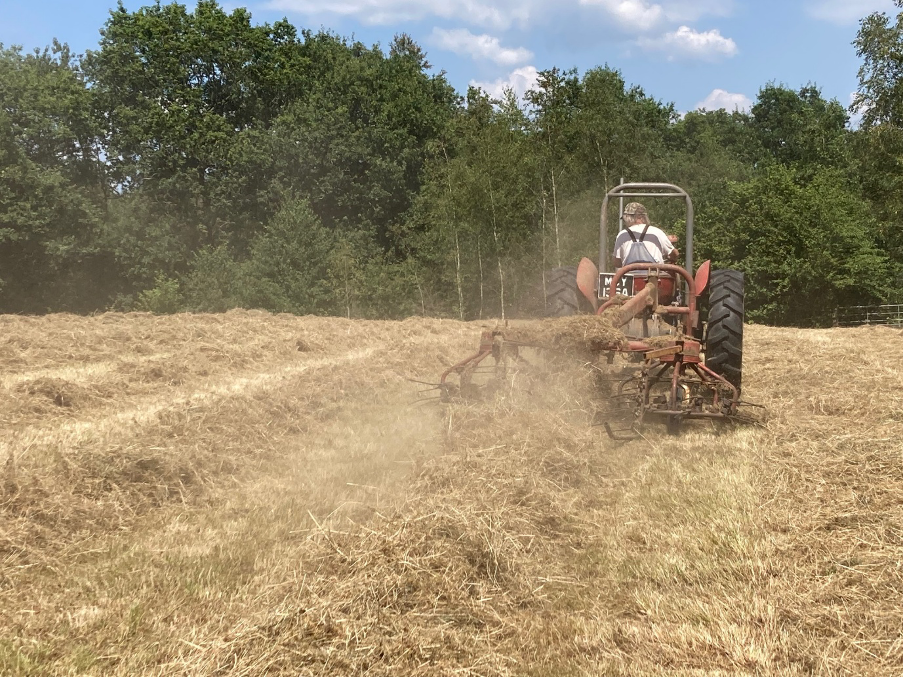
it was too dry and brittle in some areas of the fields, and putting it into rows for baling broke it up even more, and this meant that the baler couldn’t pick it up, it slips between the baler’s pickup mechanism fingers!
But despite this, and even though there were two areas of the fields still uncut, the mini round baler still managed to produce 76 bales. None of them were moist enough to need wrapping as haylage, and they were all bought by our sheep farmer friend whose sheep do our aftermath grazing.
There was still a lot of overly dry broken up hay that the baler couldn’t pick up. It was a hot and dusty job to rake it all up by hand in full sun and 30-degree heat! It, plus some not overly dry or broken up hay in an awkward area of the field that was too difficult to get at with the baler, was put into a lot of builders’ bags. Fortunately, a use was found for it – the Lluest Horse and Pony Trust were fairly desperate for hay because the hot dry weather means that the grass at their farm near Llangadog just isn’t growing and they need hay to feed their animals. We took several trailer loads of the bags of hay over there, and they were very grateful for it. Nice not to have to take it to the tip, which is what happened to the hay I couldn’t dry, cut in September 2003.
I’ll cut the hay in the remaining parts of the fields as usual sometime in the 2nd half of August – weather permitting! I’ll have the option of wrapping the bales as haylage if there aren’t enough consecutive rain-free days to make hay, nice to have that option. Hopefully we will have some rain soon – the cut fields look more like desert than meadows at the moment, they normally start greening up a day or two after cutting but not this year!
Andrew
 Carmarthenshire Meadows Group - Grŵp Dolydd Sir Gaerfyrddin
Any chance you could do 6-7 acres near Lampeter? Cut and remove, happy to pay for fuel etc
LikeLike
Dear Andrew My goodness you deserve a medal for commitment! Well done you for finally managing to get the hay baled up.Our local farmer cut our meadows on Saturday. The dust was incredible and the cut doesn’t look huge but there is a lot of knapweed and vetch in it. I said to the farmer he can make some good hay with it and he responded that there was too much Yellow Rattle in it! I have never heard yellow Rattle to be toxic to livestock so am now about to google this one. Its such a shame when they come and use all the ghastly plastic to wrap the hay up.We had to get ponies in to crop ours last winter as it was too wet to cut the previous August. It’s a lottery isn’t it. Lovely to hear your story, thank you best wishesSarah
LikeLike
By coincidence our 5 acre field at Blaen Tir has been cut last week – the earliest ever. The farmer said he was cutting and baling all his fields and didn’t really want to come back just for ours this year. It seemed very early especially for the scabious and knapweed but It was a case of saying yes or finding another way of cutting it. So I told myself it was an experiment and will be interested in seeing what happens next year. Now with yours as well we have two looks at early cutting
LikeLike