From our Chairman, Andrew:
Our Autumn Meeting on Saturday 31st October (at Bancyfelin Village Hall) will include discussion about the effects of this summer’s drought on meadow management. This article is about its effects on our smallholding. We have managed our hay meadows for maximum species diversity over the years, and left the hay cut as late as possible so as to allow more species to drop seeds (see this article on the blog: https://carmarthenshiremeadows.com/2024/08/21/late-hay-cut-pros-and-cons/.
This can be a worrying process. The later in the year you leave the hay cut, the shorter the day length, and the lower the position of the sun in the sky – that makes a big difference in how easy it is to dry the hay. Those readers who were at the Spring 2024 CMG meeting will remember the talk by Laura Moss about the various snags and problems she had with her haymaking late in the year – it was in the first week of September 2023 – they included one baler man being on a ferry to Ireland, another prioritising the meadows at the then Prince Charles’s place near Myddfai, a baler tyre puncture, his tractor running out of fuel, and the baler running out of twine. I also cut my fields that week of September 2023, and about 1/3 of the hay was in so much shade from the tall treelines next to the fields, it wouldn’t dry enough to bale. So, both Laura Moss and I said “Never again”.
In our meadows, since the first Southern Marsh Orchid appeared in 2017, the Orchids and Knapweed (both drop seeds quite late in the year) have spread well, and since they’re perennials, it seemed reasonable to cut the hay in July, with long day length and high sun. What could possibly go wrong?
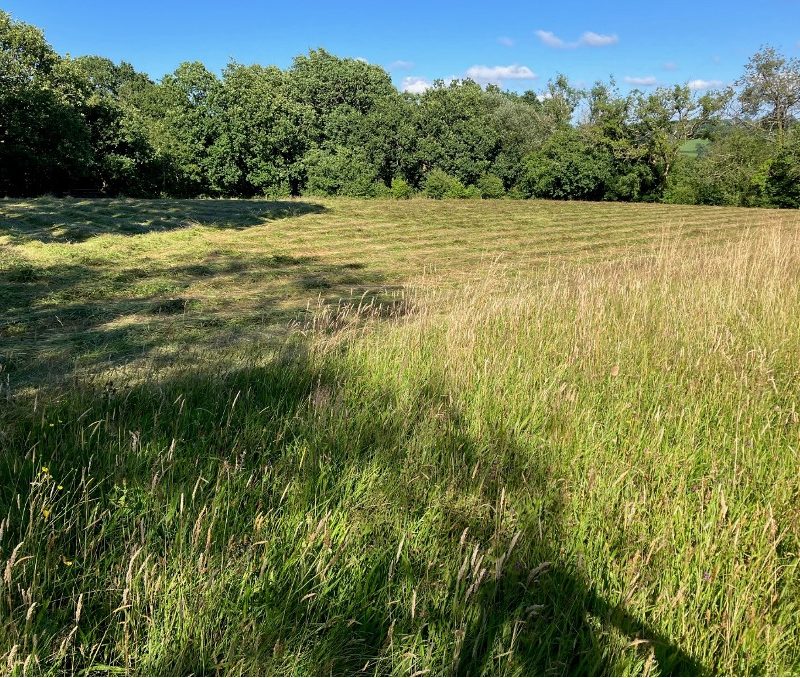
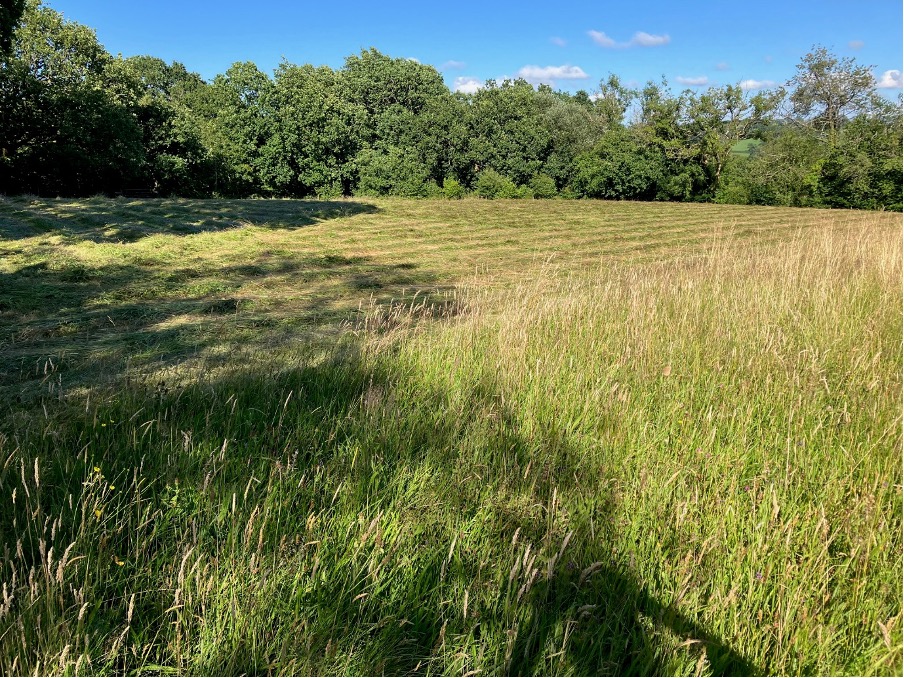
All the haymaking kit had been checked over in readiness for use. The fields seemed lusher and the grass thicker than usual, this might be due to the heavy rain in late winter/early spring followed by very warm weather. So, I was expecting a record number of bales this year. I’d also decided to leave a section of each field uncut for now, so that the wildflower meadow habitat here didn’t all disappear at once. If it does, all the invertebrates who depend on it have nowhere to go, so it’s a good idea, if possible, to not cut all the meadow in one go. Also, this year, some Greater Butterfly Orchids had appeared for the first time here, and their seed heads were nowhere near ready to drop their seed in July, so the area where they were was left for a later cut. The mowing went well, and in this picture the foreground shows one of the areas left to be cut later:
With the weather so hot and dry, it seemed the hay would only need turning over a few times before it would be dry enough to put into rows ready for baling. I use a haybob to do the tedding and the rowing up. Having checked the haybob’s tyre pressures (they were both fine), I started on the tedding. This involves going round the field in an anticlockwise direction – the haybob is offset to the left of the tractor’s line of travel, and can make left turns more easily. I usually turn the hay once in late morning when the dew has evaporated from it, and again late afternoon. I thought one more day with 2 lots of tedding would be enough, given how dry the hay was already. Next morning, I turned the hay again. In the afternoon, after doing several laps of the field and noticing a lot of dust being produced, I discovered that one of the haybob’s tyres was completely flat. There isn’t a local supplier where I could get another tyre or an inner tube at short notice. After ordering two new tyres and tubes online, I nipped out to Halford’s and got a tin of puncture repair liquid that you spray into the valve and re-inflate the tyre, and the liquid seals the hole from which the air was escaping. This worked, in that the tyre then stayed up, but because it had been running while flat (and was a very old tyre, somewhat perished) the sidewall now had a split in it. But all seemed well, and I put the wheel back on the haybob so it would be ready for work next day.
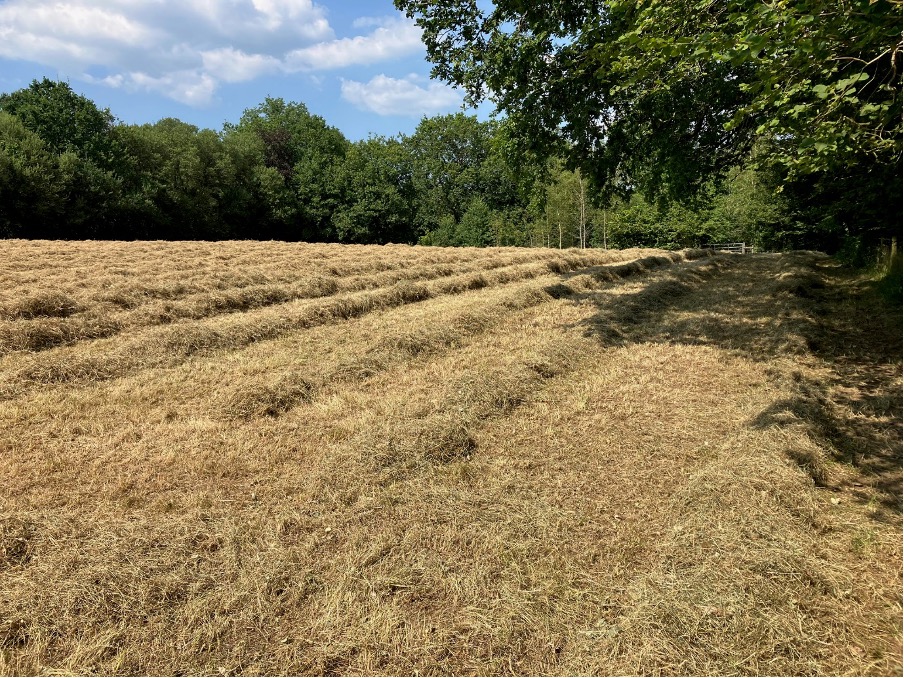
Late the following morning, all seemed well for the first couple of laps of the field, but then there was a loud bang. The inner tube had burst out through the split in the tyre’s sidewall. The haybob was therefore out of action until the new tyres and tubes arrived. Meanwhile, the heat was drying out the hay, which was lying on bone dry ground. The new tyres and tubes arrived late afternoon next day, and I took off both wheels and fitted them. The following day, I set up the haybob to produce windrows, and rowed up the hay. But it was now so dry that the grass leaves were just breaking up rather than hanging together as they usually do. These were windrows of very dry hay:
Next day, I started on the baling. I use a mini round baler:
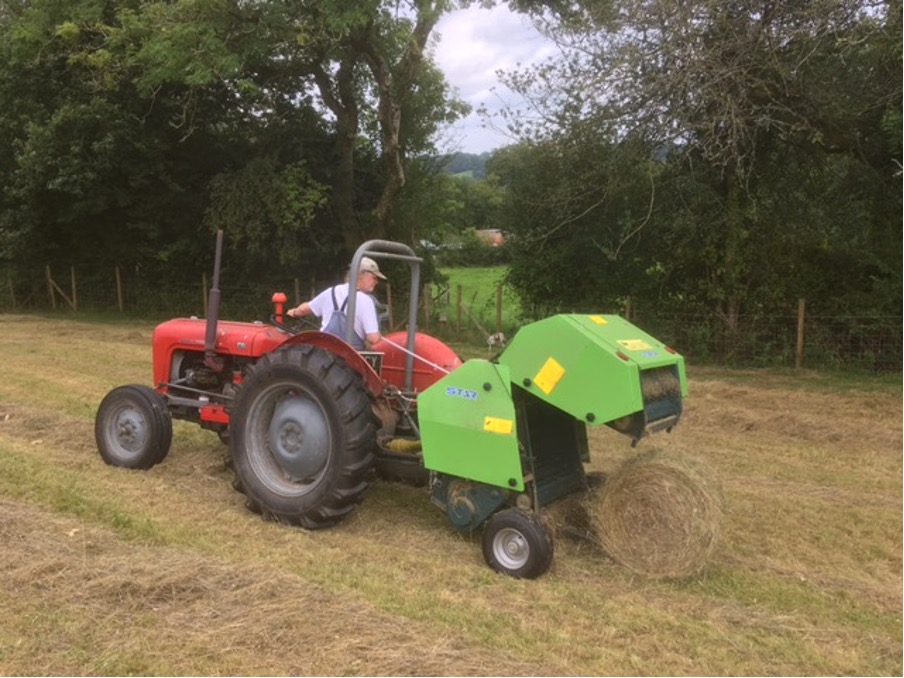
It collects the hay via its pickup tines, which rake the hay up into it. But because the hay was so dry and had started to break up, it didn’t hang together, and the baler wasn’t able to pick it up as it normally does because many of the short bits of dry grass were slipping through its fingers!
The baler did manage to produce 76 bales, which went to a local farmer as winter feed for his stock, but there was still a lot of unbaled hay left on the field. It can’t be left there; it will just compost and raise the soil fertility – the opposite of what’s needed for a species-rich meadow. So we raked it up into piles by hand, and put it into builders’ bags, and took it to the Lluest Horse and Pony charity near Llangadog – other CMG members did the same with hay they didn’t have room for, and it was very gratefully received by Lluest – they were very short of food for their Horses and Ponies as all their fields were brown because of the drought! They were kind enough to give CMG a big thank you in “The Post”.
So, having said “never again” about haymaking in September a few years ago, I had to do it again this year, with the section of each field which had been left uncut. I had left a wide strip on the south edge of both fields, but rather than a tall treeline shading much of the field, there are quite low hedges on the south sides. All the kit was checked over again, including the haybob’s nice new tyres, and I mowed the hay in both fields on Sunday 20th September. Monday and Tuesday I tedded the hay twice, and Wednesday it was tedded again in the morning, and put into windrows in the afternoon:
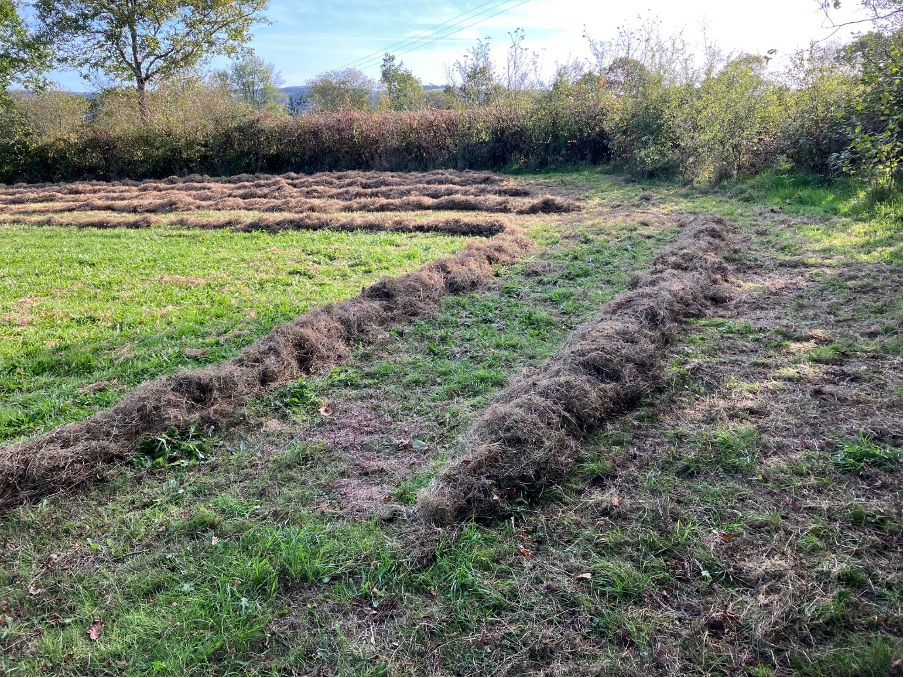
Some of the hay (which had been in the SE corner of each field and in the shade much of the day) was still too wet, but most was fine. It produced 7 more bales, which were much moister than would be ideal for hay, so they were wrapped as haylage. There was a small trailer load of very wet hay, which was taken to the tip and will end up in Merlin’s Magic compost.
I think I will continue to leave a part of each meadow uncut after the main hay cut in future years, but probably it will be strips down the middle of each field rather than on the edge, and that would mean there was less of it in the shade during the short days with low sun. Haymaking in meadows is an odd activity. The fields are there all year, some of the time with animals grazing them, and they are a haven of peace and tranquillity. But each year, there are a few days of frantic activity. The haymaking kit is only used on those days each year, and unfortunately that is the only time it’s going to go wrong or break down.
To end on a quote about haymaking, I found this one from an anonymous farmer: “A farmer’s definition of a perfect haymaking day: 90 degrees, zero humidity, a stiff breeze, and a working baler. So, about once every seven years.”