
Like London buses, no posts for a while, then 2 in 2 days!
Many thanks to Andrew and Helen Martin for the very interesting feedback, and images below, about their experiences of using imported Yellow Rattle seed as a means of weakening grass growth and encouraging floral diversity in their meadows at Ffos y Broga, Dryslwyn:
Our meadow here at Ffos y Broga, though we call it “the top field” is very much more lowland than Gelli Uchaf.

OLYMPUS DIGITAL CAMERA
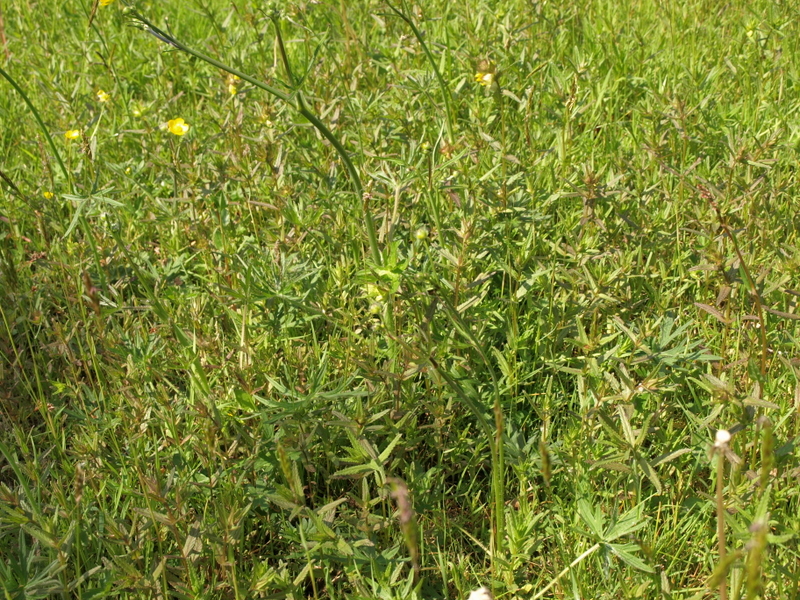
It too is responding well to warm temperatures and no shortage of water. This is the one shown being cut for haylage in a previous post of ours. Like Julian and Fiona’s meadow, it is very dense with yellow rattle. We decided some time back that there is good reason to intervene in meadow restoration to the extent of helping the yellow rattle establish:
http://www.conservationevidence.com/actions/129
OLYMPUS DIGITAL CAMERA
We originally sowed strips of yellow rattle in slots cut in the turf across the field using seeds we collected from a neighbour’s meadow in autumn 2014, and again in autumn 2015.

OLYMPUS DIGITAL CAMERA
But it has really taken off this year. We think it’s because the haybob (see previous post on haymaking) is particularly good at flinging the seeds about as well as fluffing up the grass for drying, so rather than being in mainly discrete strips it’s now ubiquitous. Like Julian, we were a bit concerned that we were creating a Rhinanthus monoculture, but others (including Chris and Rosie Plummer, the owners of the field where we collected the seeds) tell us they have found it reaches a peak after a few years and then settles down at a lower density, presumably in equilibrium with the grasses on which it is hemiparasitic.
This year, we are also managing the neighbouring field (known by the inspired name of “the middle field”) as a wildflower meadow.

OLYMPUS DIGITAL CAMERA
Last autumn we sowed three strips of yellow rattle seed across this field as well. Rather than cutting slots in the turf to sow the seeds into as we had with the top field, we just used a mower to cut the strips and scattered the seeds in the short grass, enlisting the help of some sheep to tread them in. They have germinated very well.
OLYMPUS DIGITAL CAMERA
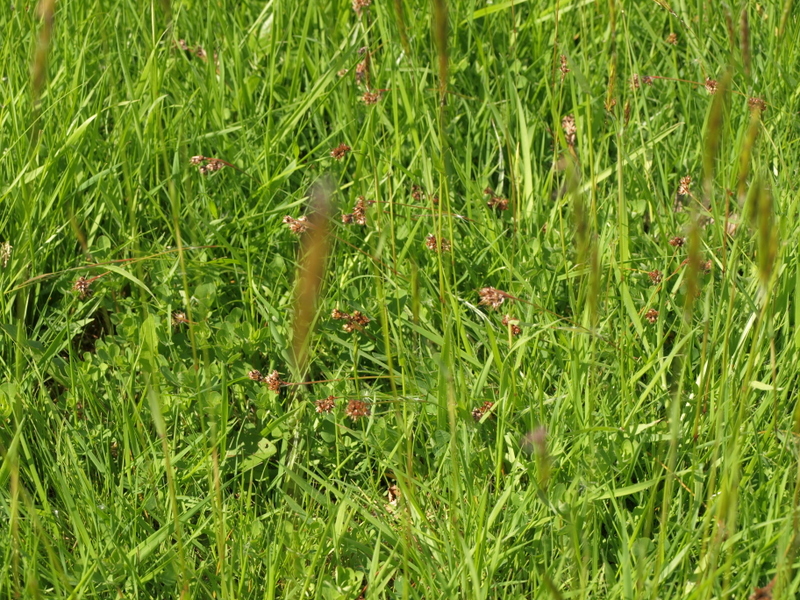
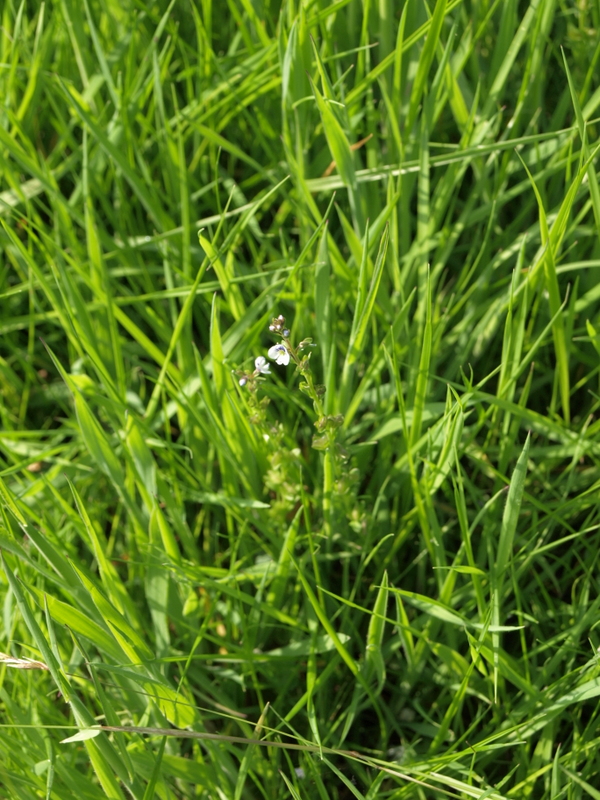
Until a couple of years ago both top and middle field had exactly the same management – they were sheep grazed, and there was no effective fence between them so the sheep had the run of both. As far as we know this had been the case the case for at least 15 years. However, they are not the same in terms of flora. For example, in the wetter parts of both there are areas of soft rush (Juncus effusus), but the middle field also has quite a lot of what we believe to be field woodrush, (above – we are happy to be corrected by anyone that knows better) of which there is very little in the top field. There has always been more common birdsfoot trefoil (Lotus corniculatus) in the middle field as well, although more is now appearing in the top field, as is greater birdsfoot trefoil. The top field is currently yellow with meadow buttercup (they both have creeping buttercup in the wetter areas), but middle field also has thyme-leaved speedwell which we don’t see much of in the top field…
OLYMPUS DIGITAL CAMERA
and one of the hawkish complex which we believe to be cat’s ear…

OLYMPUS DIGITAL CAMERA
just coming into flower. We’ll see what happens as the year rolls on…
Please see the separate events pages for details on all the other upcoming meadow visits, but some additional ones are listed below.
Many thanks to Isabel Macho for collating these :
————————————————————
Talk and walk at Cae Blaen Dyffryn
Meet at Carreg Hirfaen School, Treherbert St, Cwmann, Lampeter SA48 8EP
Sunday 19th June
1pm – 3pm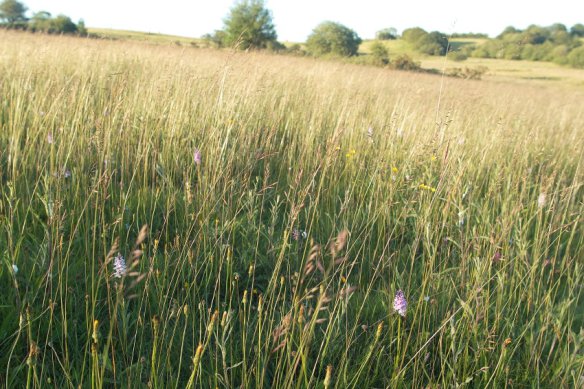
This is a great opportunity to find out more about the Coronation Meadows project which is transforming meadows across Wales and beyond. There will also be a visit to Cae Blaen Dyffryn – a Plantlife reserve and also part of the Coronation Meadows project. This site is rich in grasses, ferns and wild flowers including the rare greater butterfly-orchid, lesser butterfly-orchid and moonwort. You’ll find out about how the reserve is managed and the changes it has seen in species over recent years.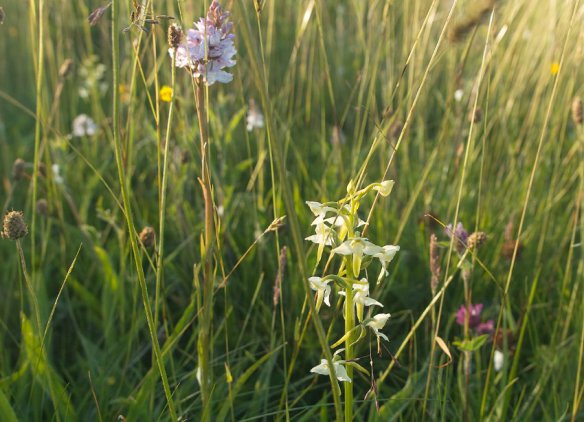
The first half of the session will be indoors where there will be a talk from Coronation Meadows Project Manager, Dan Merrett. We will then head to the reserve for a guided walk with Colin Cheesman, Head of Plantlife Cymru.
To book your free place please contact Helen Bradley, Outreach Officer by helen.bradley@plantlife.org.uk or 02920 376193 by Monday 6th June.
Carmarthenshire Meadows Group – Summer Social
Dinefwr National Trust, Llandeilo
Wednesday 29th June
10.00 am-12.45pm
Come along for a relaxed morning at the beautiful Dinefwr Park. We’ll begin in Newton House with talks from PONT on conservation grazing and also from Plantlife Cymru on what plants can reveal about the health of a meadow.
After some tea and cakes, we’ll take a short stroll to the meadow in the grounds of Newton House to find out more about its history and management from the National Trust and take a look at the wild flowers that are in bloom.
To book your free place please contact Helen Bradley, Outreach Officer by helen.bradley@plantlife.org.uk or 02920 376193 by Monday 6th June
—————————————————————————————————————
Thanks for reading.
 Carmarthenshire Meadows Group - Grŵp Dolydd Sir Gaerfyrddin
A few years ago I took a call from Tim Bevan, at the time the Estate Curator for Waun Las NNR at the Botanic Garden. He was worried by the huge volume of yellow rattle that suddenly appeared in one of our hay meadows. We consequently saw a dramatic reduction in in the larger grasses, then a year later a dramatic increase in ribwort plantain Plantago lanceolata. But that too has settled down, and after a noticeable increase in eyebright Euphrasia spp. last year we saw a significant increase in the spread and volume of four different species of orchid. Message is – relax and enjoy the ride.
LikeLike
Thanks for that Bruce…a brilliant bit of practical experience to share. I only wish we’d started our journey a bit sooner! But I still wonder whether you know of a scientific reason to explain what’s going on with these plants ….do they exhaust a (micro?)nutrient? Are they knocked by a pathogen – bug, fungus, insect? Is it all down to fungal interactions beneath the soil surface?
It seems such a common feature with many native and garden plants as well, whether annuals or short lived perennials. Any information or lines of enquiry would be very gratefully received,
best wishes
Julian
LikeLike
Pingback: October Meeting and Future Development of the Meadows Group | Carmarthenshire Meadows Group – Grŵp Dolydd Sir Gaerfyrddin