
Many thanks to Andrew Martin for the following brilliant inspiring post and photos, about how to encourage barn owls to nest on our land …
Thanks for the post about birds, Julian, and yes it looks like a buzzard to us. Lovely to see the woodcock as well. We’ve seen one fly up from the bank on the edge of our meadow once.
A big deal for bird conservation, that meadow group people might like to consider, is putting up a nest box for barn owls. There is excellent advice on the website of The Barn Owl Trust. Click here for more.
This includes designs for them (both for inside buildings and outside on trees) and where to site them. The point is, grassland not grazed down to lawn height will probably support a population of field voles. We are also lucky in Carmarthenshire in that there is not much arable farming, so there has not been the same move towards pulling up hedgerows to create huge fields as in other parts of the UK. Sheep especially like hedgerows for shelter, and hedgerows are also areas of maximum activity for small mammals such as woodmice, bank voles and shrews. So smallish fields that are not intensively grazed are really exactly what barn owls need for good hunting.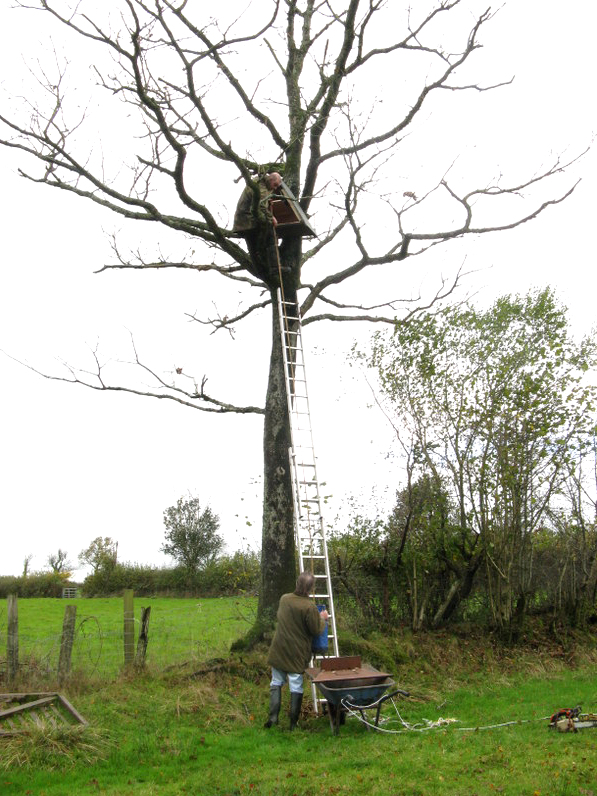
In winter 2014/15 we (with the aid of a tree surgeon we know) put a home-made barn owl box up in an oak tree on the edge of our meadow. The usual advice is that it will probably be there for a couple of years before it is used. To our surprise, a barn owl started roosting in it not long after we’d put it up, and to our even greater surprise a pair had a late brood in it in 2015.

OLYMPUS DIGITAL CAMERA
This summer they didn’t nest in the oak tree box, but they did in another box we put up inside an outbuilding, so they seem to readily use artificial nest sites if provided. It may be that in this county, it’s availability of nest sites that is limiting their breeding, rather than suitable hunting habitat. Another advantage of having them nesting in a box by your meadow is that you can collect and analyse their pellets to see what they have been eating. The Mammal Society publishes a useful key to identifying small mammal remains in owl pellets. Click here for more.
Hours of fun on the long winter evenings!
 Carmarthenshire Meadows Group - Grŵp Dolydd Sir Gaerfyrddin
Thanks you for the information and link- it’s really great.
LikeLike
That’s interesting. Yesterday, one of the Botanic Garden’s volunteers, Keith Crowden, came face to face with a barn owl in one of our disused barns. There’s an old barn owl box in this barn but it has never been used as people think where it’s sited is too light. Presumably on your tree, the box will be shaded by leaves?
LikeLike
Hi Bruce, good to hear another bit of biodiversity has turned up at the Garden! Actually our box in the tree is hardly shaded at all by foliage, it’s quite a small oak. Barn owls will use boxes like this on poles with no shade at all, so I don’t think it really matters, as long as they have a cavity (box) to hide/roost/nest in. They can also be habituated to tolerate disturbance if they are using a box in a building, so long as they have a box cavity to hide in. The Barn Owl Trust says that any modern farm building can be used for nesting if there’s a suitable box in it, they will even nest in small industrial units. So it’s worth putting boxes up. But they are very heavy! The one in our oak tree was almost a whole 8′ x 4′ sheet of exterior ply, which is why we had to use ropes and pulleys to get it up there. Indoor ones can be lighter as they don’t need to be weatherproof.
LikeLike